
Since the mid-19th century that research has been made in growing gem-quality crystals in a scientifically controlled environment with early attempts in synthetic emerald (not successful until 1920) and later, in 1885, with the announcement of the first synthetic rubies.
Firstly, let us clarify what is a synthetic stone (according to World Jewellery Confederation – CIBJO nomenclature): it is an artificial product (meaning man-made) with essentially the same chemical composition and crystal structure as an existing natural counterpart, having similar gemmological properties.
In jewellery, early commercial quantities were indeed known since 1885 (roughly until the early 20th century) with the flux-grown synthetic rubies, known by the misnomers “Geneva rubies”, “Wyse rubies” or even “reconstructed rubies” (a rather questionable way to market artificial products, even today). Interestingly, in 1886, the French Syndicate of Diamonds and Precious Stones ruled that these products should be disclosed as man-made to protect consumer confidence.

With the massive production of cheaper flame-fusion synthetic rubies, grown by the method developed by Auguste Verneuil, first displayed publicly at the 1900 World Exhibition in Paris, France, and later with other synthetics, the use of good quality artificial products in the decorative arts became widespread and typically understood as low-cost artificial (not-natural) lookalikes. The term “synthetic” was then used worldwide, in its many translations with this meaning.

It was not until the early 2000s when synthetic diamonds of gem quality became a cost-effective product and a serious business for mass market that lobbying for acceptance of a new way of naming these products was strongly pushed by many interested parties and terms “laboratory-grown” or “laboratory-created” were marketed (often by shorter “lab-grown” spellings).


Many stakeholders, as legally in France for example, still choose only to use the traditional term “synthetic” to describe all these artificial products. What is your take on this terminology issue in your language (if applicable the translation)?
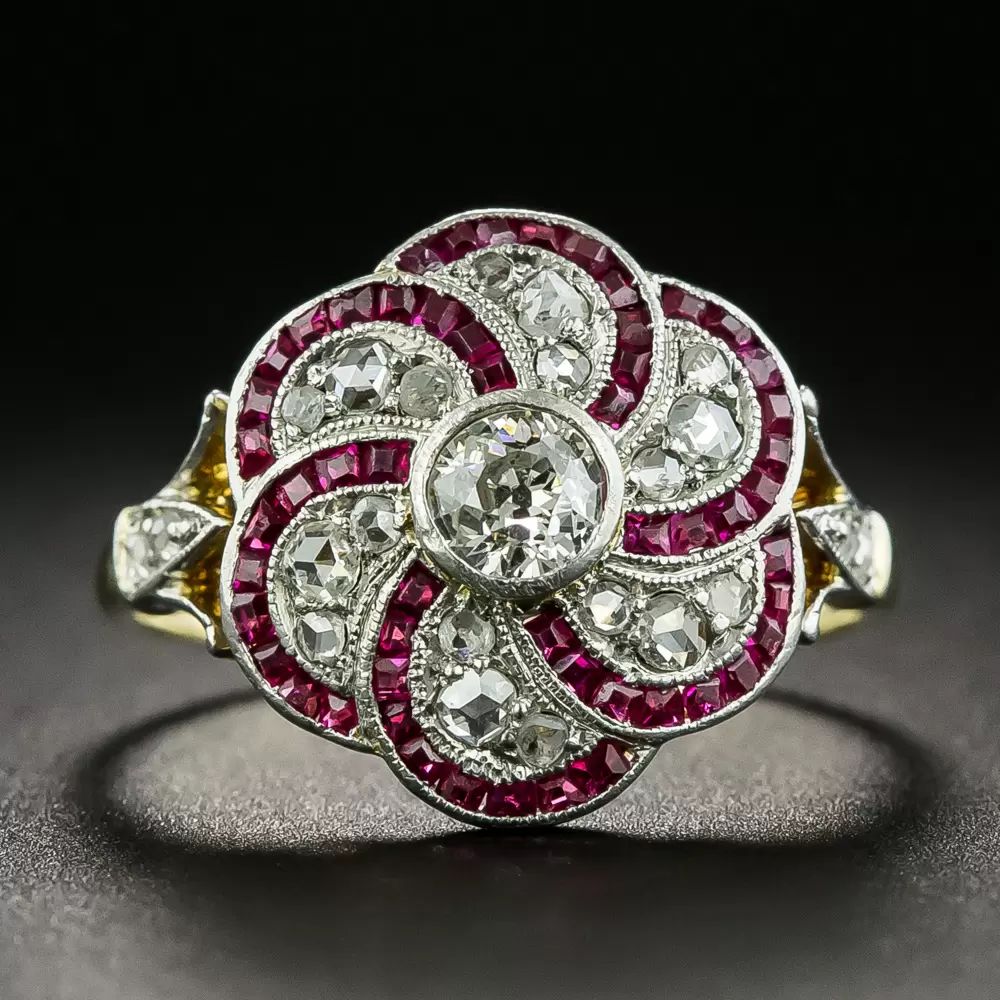
In the images, synthetic sapphire and synthetic ruby jewellery (set with diamonds) © Lang Antique and Estate Jewelry; Cover of the book “Synthèse du Rubis” by Prof. Edmond Frémy, 1891.

Guest articles by Rui Galopim de Carvalho:
https://gem-spectrum.com/category/rui-galopim-de-carvalho

About the author:
Rui Galopim de Carvalho is a renowned independent Gem Education Consultant, author, luxury industry training expert and popular international lecturer on gemmology and on the history of gem materials. During his 30 year experience as a gemmologist, Rui has studied important collections in both public and private museums, notably the Portuguese Crown Jewels.
Founder of the popular Home Gemmology webinar series launched during the COVID-19 lockdown, Rui has a long history as a gemmology communicator, notably on social media where he is a popular figure.
He is associate editor of Gem-A’s Journal of Gemmology, Vice-President of the Coral Commission of The World Jewellery Confederation – CIBJO, member of the Communications Committee of ICA (International Colored Gemstone Association), ambassador for LAUREL -Portuguese Association of Excellence Brands (ECCIA member) and consultant for several private collections and trade organizations.
Rui Galopim de Carvalho can be reached through his website: