a guest article by Lotus Gemology

2025 has been a year filled with discovery and discussion. Lotus Gemology has been involved with many of the current market topics while innovating new services and resources to assist the trade.


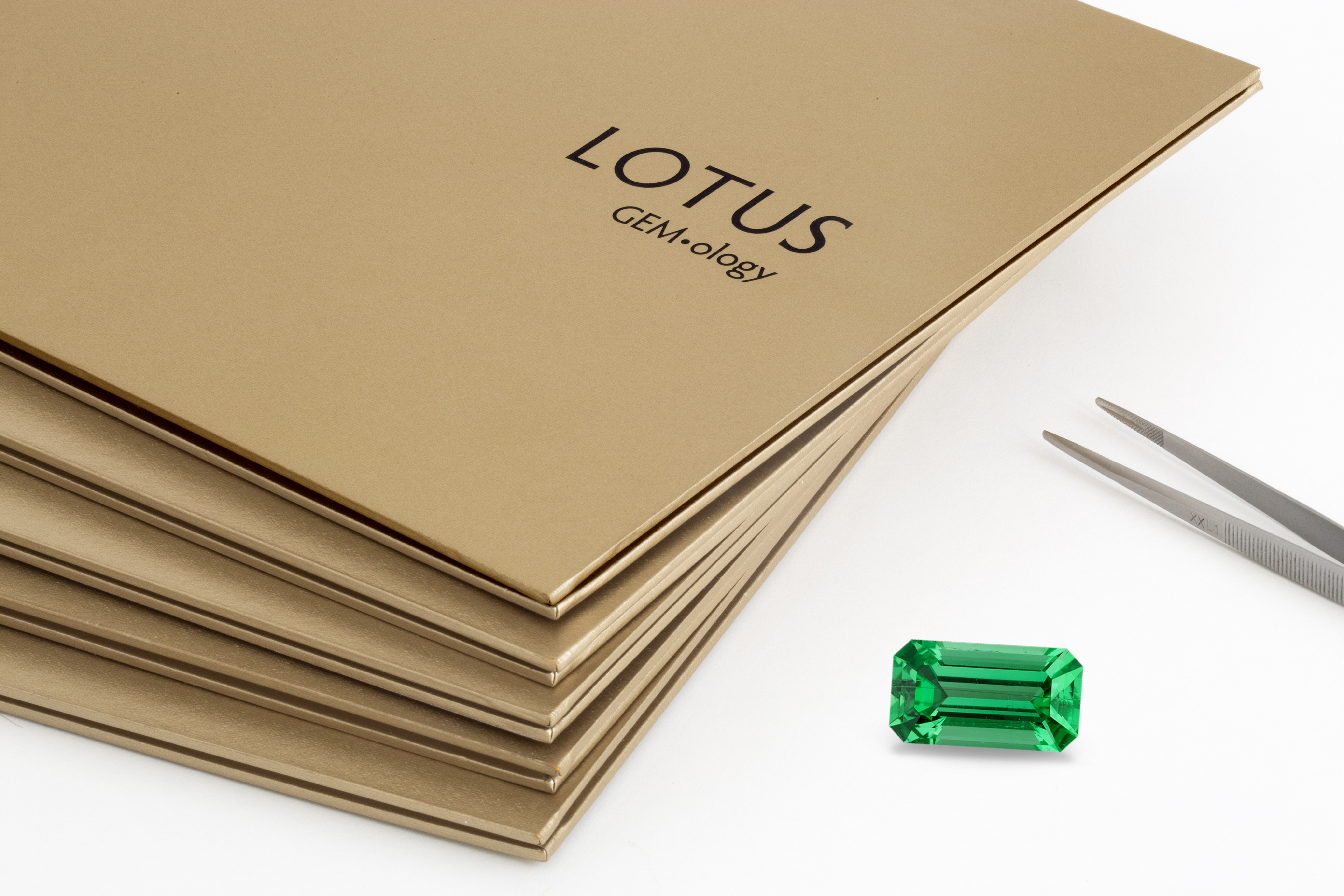
For many years, Lotus Gemology has offered premium hardcover reports for ruby, sapphire and spinel at affordable rates. This service has been extremely popular for high-end gems, assisting dealers with the story-telling aspect that is so important in the gem trade.
In 2025, we expanded our premium hardcover gemological testing and grading report offerings to include:
- Jade
- Demantoid & Tsavorite garnet
- Tourmaline (including cuprian)
- Alexandrite
- Imperial Topaz
- Emerald and other Beryls (all types including aquamarine, morganite, heliodor, etc.)
Lotus Hardcover reports are elegant, highly customizable 15+ page reports with full-color photographs created to celebrate the rarity and value of gemstones.

The subject of jade is built on vast quantities of literature published in many different languages and yet, in a time before the internet, a German polymath named Leopold Heinrich Fischer managed to track down every reference to jade he could get his hands on. His subsequent treatise on the subject Nephrit und Jadeit was published in 1875 with a second volume appearing in 1880.
This extraordinary work is by far the most comprehensive to ever appear on jade. Up until now, only scanned versions of the original German version were available. The recent rise in AI-fueled machine translation has made it far easier for researchers to access information in foreign-language publications.

Lotus Gemology’s Richard W. Hughes has taken advantage of this technology and produced an English translation of this important discourse, supplementing it with his own jade bibliography.

Following the publication of Jade • A Gemologist’s Guide in 2022 and Broken Bangle • The Blunder-Besmirched History of Jade Nomenclature in 2024, the English translation of Nephrit und Jadeit has rounded out Richard’s jade trilogy.
Available via print-on-demand at Lulu.com here.
Research Tools
Lotus Gemology has refurbished popular tools such as Hyperion and Four Treasures to increase user-friendliness. These are available on LotusGemology.com for free to assist gemologists with a variety of gemological problems.

Thousands of hours of work have been put into their development and maintenance. This is our way of giving back to the gemological community.
The Hyperion Inclusion Search Engine is the world’s first inclusion database, filled with a whopping 1,700+ photomicrographs. Here, one can simply browse stunning inclusion photomicrographs, or sort by gem type, origin or treatment.
Sherlock Solid Inclusion Registry
Think of the Hyperion Sherlock as an advanced gem inclusion search engine. It allows readers to make their inclusion searches by gem type (such as host gem species; corundum, beryl, etc.) and inclusion identity (rutile, mica, etc.).

Users of this advanced inclusion search engine can also search by country, locality and geology. This means searching by host country of origin, specific localities in that country, or a geology keyword (like basalt, pegmatite, marble, etc.).
Each inclusion is fully documented with references of when it was first discovered.
Siamese Twins
This special gallery features patterns encountered when studying paired images from Lotus Gemology’s Hyperion Inclusion Database. These patterns include featured paired images, sets of inclusion photomicrographs, pairs of spectra and more, allowing readers to directly compare contrasting features.

These sets provide insights into treatment detection, geographic origin, and the art and science of photomicrography; as patterns emerge not just from single images, but from the relationships between them, and how these connections deepen our understanding of gemological science.
Four Treasures Reference Database
The simple tools of brush, ink, paper and ink stone, known in China as the “Four Treasures,” give humanity the power to communicate across time—even beyond death—granting immortality to knowledge. Inspired by their enduring significance, we’ve named our reference database in their honor.

We at Lotus Gemology believe that scholarship belongs to all humankind. Towards that goal, we have opened access to our Four Treasures database which has been built over nearly four decades and thousands of hours of dedicated work—free of charge.
The database includes thousands of references in gemology, mineralogy, and related fields, with particular strengths in corundum, jade, emerald, spinel, color science, glyptic art, history and Arabic-language sources.
Lectures
From discussions on nomenclature to reviewing major treatments in the industry, our lectures have spanned the globe, teaching like-minded industry professionals about the world of gemstones.
During 2025, Richard Hughes traced the fascinating and at times bizarre nomenclatural history of jade and jade-like gem materials from early times to the present in Tucson and China, and gave short tutorials on the fundamentals of color science in Tucson and Hong Kong.
Meanwhile, Billie Hughes had taken participants through the journey into the center of a gem and discussed treatments of ruby and sapphire in Tucson; and reported results from low-temperature heat treatment experiments on Burmese ruby in Japan.
We also had the pleasure of joining Van Cleef & Arpels for an educational event in Bangkok. Billie Hughes and Olivier Segura from L’ÉCOLE, School of Jewelry Arts, Asia Pacific shared their passion for the colorful world of gemology.
Our gemologists have spoken to a variety of audiences with all levels of expertise, from laypeople and students to leading industry professionals. We are able to custom-tailor lecture programs to meet any group’s requirements, as well as deliver our popular favorites.

Articles about Lotus Gemology and Billie Hughes:
https://gem-spectrum.com/tag/billie-hughes
https://gem-spectrum.com/tag/lotus-gemology
Articles about Thailand:
https://gem-spectrum.com/tag/thailand
This article was published on Gem Spectrum print magazine issue #6 (Winter 2025-26), Page 20. Browse the Flipbook here. Full-screen viewing and download are possible.