by Jacques Voorhees, Founder & CEO, Icecap.AI
AI chatbots are driving sales for jewelry industry websites.


For the past 30 years, we’ve all been building websites essentially the same way.
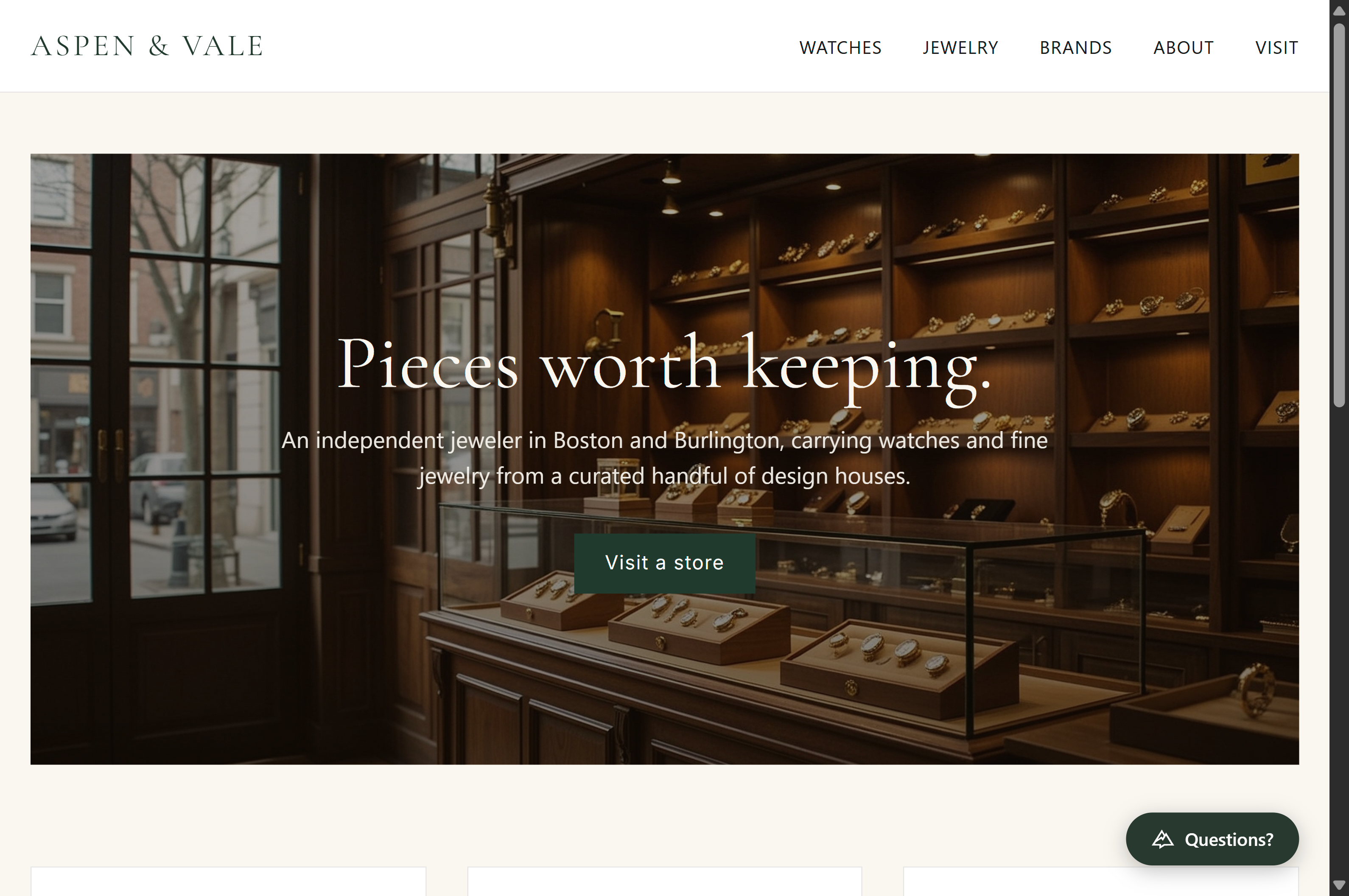
Across the top of the screen are some choices. Perhaps “Diamonds,” “Jewelry,” “Watches,” “About Us” and “Contact.” Hover over one of those and more choices appear. Click one and perhaps there are still more choices.
Or, if you’re impatient, there’s a search box.
This made perfect sense twenty years ago, because there wasn’t any alternative.
Today there is.
Think about what happens when someone walks into a good jewelry store. You don’t point the customer toward a directory and tell her to figure out where everything is. A salesperson greets her.
“Good morning. Welcome. What can I help you find?”
“I’m looking for an anniversary present for my husband.”
“Great. How long have you been married?”
“Twenty-five years.”
“Congratulations! Tell me a little about him.”
That is how human beings prefer to shop. We talk. We ask questions. We explain what we’re trying to accomplish, and another human being helps us accomplish it.
Until now, websites couldn’t do that.
That has always been one of the great disadvantages of online commerce, particularly in the jewelry industry. A bricks-and-mortar jewelry store has salespeople. Its website doesn’t.
And jewelry, perhaps more than most products, needs a salesperson.
Consumers have questions. Lots of them. What is the difference between 14K and 18K gold? Is this sapphire natural? What does “heated” mean? What size diamond should I buy? What is the difference between these two watches? My wife likes yellow gold and emeralds, and my budget is $3,000. What do you suggest?
For years, the industry’s answer has been to give the customer menus, filters, search boxes, FAQ pages and hundreds or thousands of product pages.
Artificial intelligence is about to change all of that.
THE WEBSITE BECOMES A CONVERSATION
AI chatbots are rapidly becoming sophisticated enough to do something much more useful than simply answer questions. They can greet customers, determine what they are looking for, explain products, make recommendations and guide them through the buying process.
In other words, a website can finally have a salesperson.
That is the idea behind Sherpa, a new AI system developed specifically for the jewelry industry by Icecap.AI. Icecap was founded by the same people who created Polygon in the 1980s, the first online trading network for the gem and jewelry industry.
Sherpa comes pre-loaded with extensive jewelry knowledge. But that is only the starting point.
When a jeweler orders a Sherpa, Icecap’s software examines the company’s existing website and automatically harvests its content. Within seconds, that information is incorporated into the AI.
The result is a chatbot that knows the jewelry industry, but also knows your business.
It knows your history, your policies, your services, the brands you represent, your store locations, your hours and everything else you have already put on your website. There is no need to spend days manually building a knowledge base before the system can be used.
It can literally be up and running in minutes.
“It’s about the most useful business tool I’ve ever seen,” said Katie Ulsh, Digital Marketing Manager at Mountz Jewelers in Harrisburg, Pennsylvania.
FROM CHATBOT TO SALESPERSON
Sherpa is offered at three levels.
The Basic version is free and provides the AI assistant itself. Insights adds market intelligence, allowing the jeweler to learn from the conversations customers are having with the Sherpa. What are they asking about? What products interest them? What objections are coming up? What information are customers seeking that may not even exist on the website?
The Catalog version goes a step further by connecting the AI directly to the jeweler’s product catalog.
At that point, the distinction between a “chatbot” and an online salesperson begins to disappear.
A customer can say, “I’m looking for a sapphire ring in white gold, around $5,000,” and the Sherpa can discuss the request, ask questions, search available inventory and present appropriate choices. If authorized by the jeweler, it can even negotiate within limits established by management and close the sale.
But there is another problem peculiar to the jewelry business.
A retailer doesn’t possess all the information needed to sell everything in the store.
The diamond producer knows more about its diamonds. The watch company knows more about its watches. The designer knows more about the collection. The colored stone supplier may have origin information, videos, photography, treatment information and a compelling story that never makes it onto the retailer’s website.
Sherpa was designed to address that problem as well.
CONNECTING THE SUPPLY CHAIN
Using Icecap’s patent-pending architecture, retailers can tap into permissioned online content supplied by upstream brands and suppliers.
Through a User Portal, a jeweler can test the Sherpa, train it and add information directly. But the retailer can also request information from participating suppliers.
Suppose a retailer carries a particular Swiss watch brand. The retailer could authorize that brand to supply approved product information, sales material, stories, technical information and promotional content directly to the retailer’s Sherpa.
When the brand changes the information, the Sherpa can change with it.
This creates something the jewelry industry has never really had before: a way for knowledge to move through the supply chain, automatically, all the way to the AI system talking directly to the consumer.
And that consumer may be anywhere in the world.
Sherpa currently communicates in approximately 220 languages, which is making the system useful globally.
Norges Gullsmedforbund, a Norwegian jewelry industry organization, recently added a Sherpa to its own website.
“I couldn’t believe how easy it was to set up,” said Vanja Haugland Olsen, chair of Norges Gullsmedforbund. “It only took minutes, cost us nothing, and began performing perfectly, in fluent Norwegian, the moment it was activated.”
THIS ISN’T JUST ABOUT RETAIL
“We designed this for any company in the jewelry industry, anywhere in the world,” said John Durkee, Icecap’s Chief Marketing Officer. “It’s perfect for retail jewelers, whether they sell online or just have a promotional website. But it’s equally useful for companies selling B2B, trade associations, or anyone with a website that somehow involves the jewelry industry.”
That last point may ultimately prove important.
AI chat systems aren’t merely another feature to add to websites. They represent a fundamentally different way of interacting with them.
For 30 years, we have expected people to learn how our websites are organized. We created navigation bars, menus, submenus, filters and search systems and then expected visitors to hunt through them for the information they wanted.
Increasingly, they won’t.
They’ll just ask.
And once you think about it, that isn’t particularly revolutionary. It is how commerce worked for thousands of years before the Internet came along.
The salesperson is back.
This time, the salesperson lives on the website, knows virtually everything about the business, speaks 220 languages, never sleeps, and can simultaneously talk to every customer who walks through the digital front door.
And unlike any salesperson I’ve ever hired, this one will work for free.
To install a free Sherpa in minutes, visit Icecap.AI and click Start For Free.
Articles about Jacques Voorhees:
https://gem-spectrum.com/tag/jacques-voorhees
Articles about AI:
https://gem-spectrum.com/tag/ai
About the Author:

Jacques Voorhees is a serial entrepreneur in the field of technology for the gem and jewelry industry. He is best known as the founder of Polygon, the first online trading platform for the industry, which revolutionized how the diamond market functions. Polygon launched in 1983, roughly a decade before the invention of the Web.
Polygon also worked closely with jewelry industry trade associations, to create websites for their membership. The company built over 20,000 websites for retail jewelry stores, and launched the first websites for most of the industry’s trade associations and publications such as Jewelers of America, and JCK Magazine.
After Polygon was acquired by Mediagrif Technologies, Jacques founded Verichannel, a company that builds and operates diamond trading platforms for private groups. Clients have included American Gem Society, Independent Jewelers Organization, De Beers’ Forevermark, and others.
His most recent project is Icecap.AI, a company that provides AI upgrades to traditional websites, to give them the sales power of physical bricks and mortar stores.
Jacques lives in Keystone, Colorado, USA