
Interviewed by Erika.Y, AIGS
“Never stop learning and stay connected to the community. Skills, knowledge, mentorship, and passion all grow much faster when you surround yourself with people who share the same dedication and curiosity.” — Michael Holmes
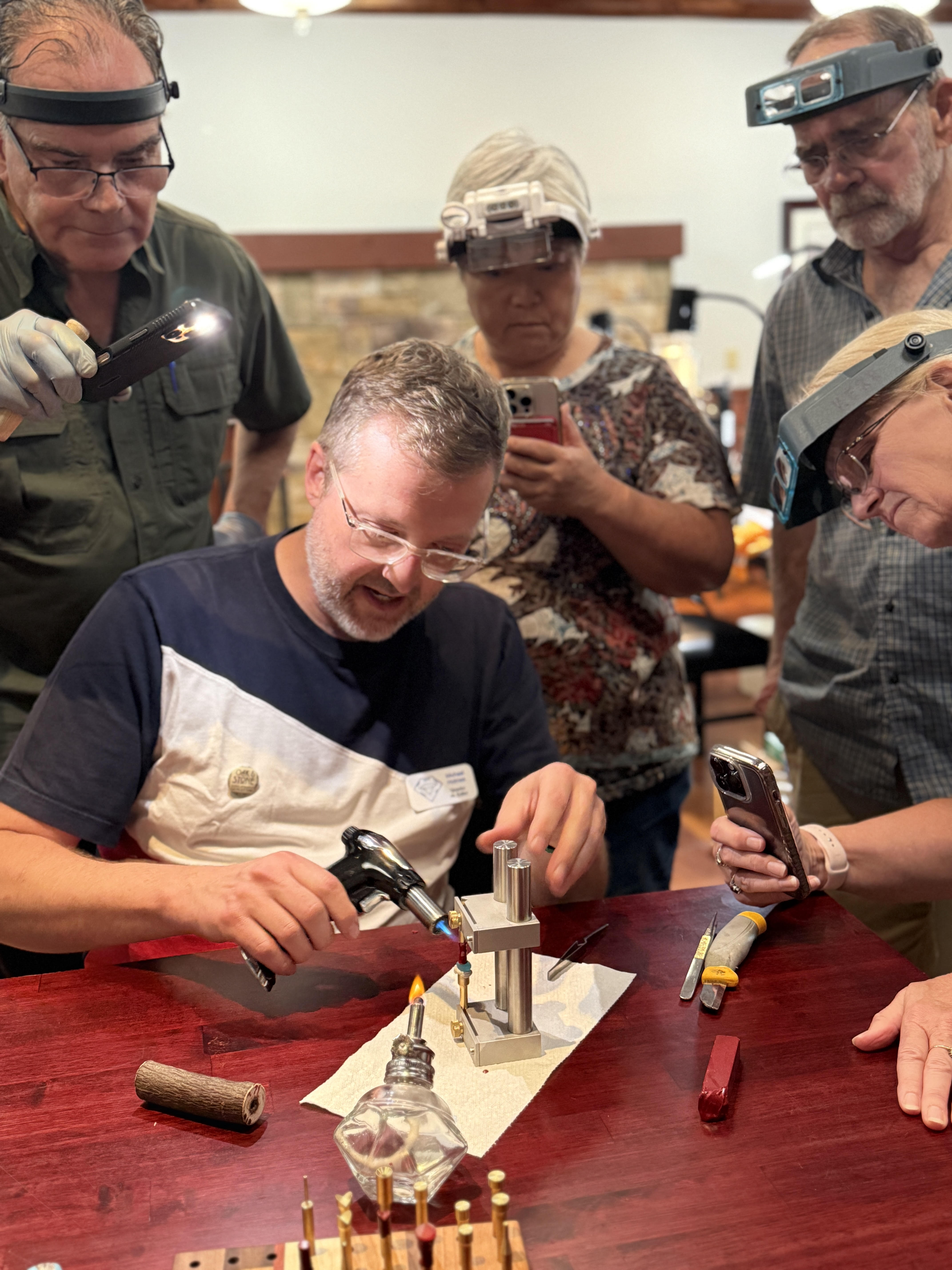
Michael Holmes is the co-founder and instructor of Oak & Stone School of American Gemcutting. Before entering the gem industry, he worked as a professional graphic designer, English teacher, and motorcycle safety instructor. A passionate gem cutter and educator, Michael is also an AIGS Gem Identification course graduate under the Accredited Gemologist Diploma (A.G.) program.
In this exclusive interview, Michael Holmes showed us how it’s intriguing all those experiences eventually connected and became useful in his current profession as a gem cutter and educator.
Q: Your journey into gem cutting is quite unique. How did it all begin?
Michael Holmes: But in 2012, gemstones, especially gem cutting, caught my attention. At first, it was just curiosity, but the more I explored it, the stronger the passion became. It was something I simply could not shake off.
I spent nearly two years searching for a gem cutting course in the United States before finally finding Tuscarora Lapidary Society in 2014. That class completely changed my life. Little did I know at the time that the people, the community, and the craft itself would eventually become the life I live today.
Your wife Kim is also involved in the journey. How important was that support?
In 2014, I convinced Kim, who is now my wife, co-founder and assistant instructor at Oak & Stone, to take a faceting course with me. It’s truly a blessing to grow alongside someone who shares the same vision and supports your passion.
At the beginning, gem cutting was simply a hobby for me, something enjoyable on the side. My wife saw how passionate I was about gem cutting and encouraged me to start sharing and teaching.
Was there a defining moment when you realized you wanted to pursue gem cutting professionally?
Yes, during the pandemic. During the work-from-home period, I spent most of my time sitting in front of the computer, and I wanted to focus on something different. I thought it would be the perfect opportunity to save money and finally purchase the faceting machine I had always wanted. In September 2020, I purchased a faceting machine and began seriously pursuing my passion from my basement workshop.
Although I had built a successful professional career over more than a decade, I realized something was missing emotionally. I noticed it for a day, then a week, then a month. Eventually, I realized the work I was doing no longer gave me emotional fulfillment. At the same time, the passion I discovered in 2012 for gem cutting had never disappeared.
Then one day, my company announced a severance package for employees who had worked there for more than five years. To me, that felt like life answering the question I had been struggling with. I discussed it with my wife, and she was incredibly supportive of my decision. Everything seemed to align at the same time. Later, I consulted with my mentors and they also encouraged me to take the leap because they understood how passionate I was about gems.

Was it difficult transitioning into professional gem cutting?
Absolutely. Gem cutting is a slow and lonely process, and in 2021 I quickly realized I needed guidance and mentorship. That’s when I reached out to master gem cutter Justin Prim, who was working on a book called The Secret Teachings of Gemcutting. I offered to design the book, since I had a background in graphic design, and I got great mentorship at a time when I really needed it. Over time, I connected with many of the top figures in the field and discovered an incredible, supportive community of fellow cutters. While making the switch was certainly a challenge, the past six years have allowed me to cultivate deep friendships and gain invaluable expertise from a diverse group of master gem cutters.
I’m very grateful to the people who guided and supported me along the way. Thankfully, the gem cutting community I found during the pandemic was incredibly supportive. People openly shared techniques, experiences, and advice, which helped me grow tremendously.
How did your previous careers help shape your current profession?
Surprisingly, every previous career helped me in some way.
As a graphic designer, I learned how to visualize the final result before beginning a project and how to create detailed blueprints for designs. As an English teacher, I learned presentation skills, classroom management, and how to explain complex ideas clearly. Working as a motorcycle safety instructor taught me how to teach and communicate effectively with adults.
Today, I apply all of those skills in my role as a gem cutting instructor.
Do you remember the first gemstone you cut after returning to gem cutting professionally?
Very clearly. The first gemstone I cut after buying my machine took me around six hours to complete. When I finally finished it, I felt something I had not experienced in a long time.

Are there any gemstones you’ve cut that remain especially meaningful to you?
There are three that stand out.
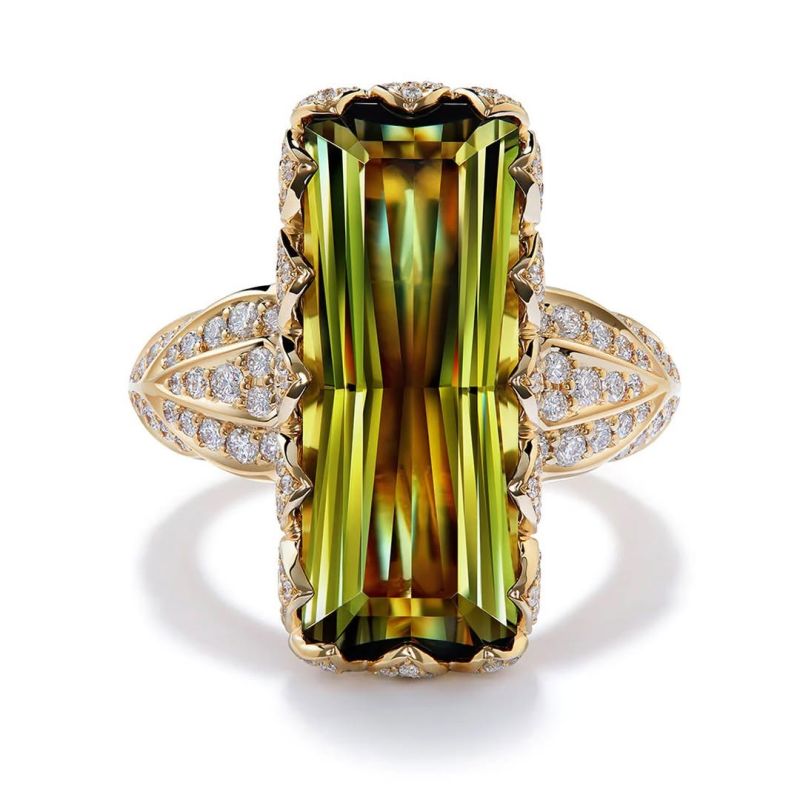
The first was a blue-green bi-color tourmaline with a dark c-axis. I managed to transform it into a beautiful bi-color gemstone while preserving its character.
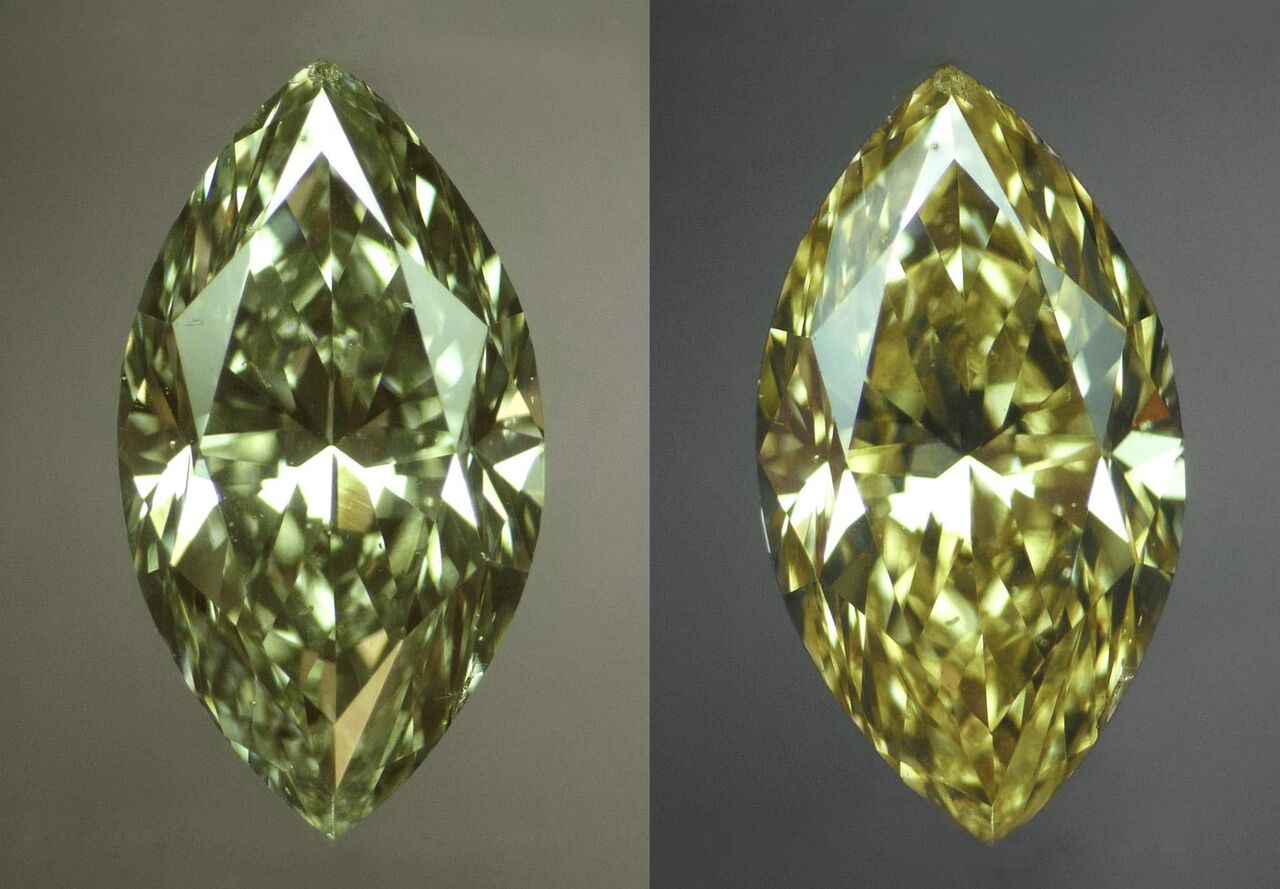
The second was a synthetic gemstone called LuAG with extremely strong yellow-green fluorescence. I successfully cut three large gemstones from it.
The third is my favorite, the aquamarine engagement ring I created for my wife Kim. In 2017, I actually took the gem cutting course for a second time to cut that ring. It took me a few weeks, but it was a very rewarding experience. Looking back, it was actually a lucky choice because aquamarine is relatively easy to cut and polish. At that time, I was still a very new gem cutter, and she chose something that was approachable for my skill level. The ring turned out beautifully.

What is the average yield percentage when cutting gemstones from rough?
Typically around 30%, and if you are very lucky, perhaps 40% at most. For example, from a 10-carat rough stone, you might end up with a finished gemstone slightly above 3 carats.
What are the biggest challenges as a gem cutter?
Yield is definitely one of the biggest challenges because profitability matters in business. Before purchasing rough material, you must calculate the potential outcome, expected yield, target market, and selling price.

Another challenge comes from the American gem cutting style itself. It involves additional precision steps and refinement processes, which can increase costs, but the final result is exceptional.
One valuable piece of advice I’ve received from industry professionals is to always think long-term and focus on consistency rather than shortcuts. Precision, patience, and reputation are everything in this field.
What makes American gem cutting different from other cutting styles?
Traditional cutting methods often begin from the crown, while American gem cutting usually starts from the pavilion and works outwards from a centerpoint. American cutting focuses heavily on light performance, precision, and polish quality.
In many traditional methods, cutters prioritize color and carat retention, while American gem cutting places stronger emphasis on cut quality and optical performance.
For example, many traditional methods polish up to 14,000 grit, while American gem cutting can go up to 50,000 or even 100,000 grit for exceptional finish and brilliance.
What defines a well-cut gemstone in your opinion?
Two important things:
First, precise facet junctions, the meet points must be sharp and accurate.
Second, proper polishing. A finished gemstone should have no visible scratches and should display excellent brilliance and shine.
How do you balance artistic creativity with commercial practicality?
For me, the gemstone should look unique and visually different, but it must also remain practical for jewelry designers and manufacturers to use. Creativity is important, but wearability and market acceptance matter too.

Do you use any special tools or innovations in your work?
Yes. I use computer software to create 3D visualizations before cutting so I can better understand proportions and performance.
I’ve also experimented with customizing materials used in the cutting process. Traditionally, lead (Pb) is used in some polishing, but because of toxicity concerns, I am working on alternative alloys to reduce those risks.
How long does it usually take to cut a gemstone?
Simpler gemstones may take around three hours, while more complex designs can take six hours or more.
How has studying gemology at AIGS helped your gem cutting career?
I studied the Gem Identification course, which is part of the Accredited Gemologist Diploma program at AIGS. It helped me understand gemstones from different mineral families, including their hardness, refractive index, and characteristics. I also learned about color orientation and scientifically identifying synthetic and natural stones. That knowledge is extremely important in gem cutting because understanding the material helps you avoid costly mistakes and achieve better results.
What advice would you give to AIGS students who want to succeed in the gemology industry?
Never stop learning and stay connected to the community. Skills, knowledge, mentorship, and passion all grow much faster when you surround yourself with people who share the same dedication and curiosity.
Any exciting upcoming plans for Oak & Stone School of American Gem Cutting?
Yes, we are planning to do more classes out of Pennsylvania, to bring out teaching and machines to other states to make it more accessible. We hope to travel to other countries eventually for classes too. Someday we will expand our learning space, most likely into a dedicated building while remaining in the same location. We’re excited to continue growing the community and providing more opportunities for students passionate about gem cutting.

About the Interviewer

Erika.Y (Erika Yu Ya) is a communications strategist and industry analyst specializing in the gem and jewelry sector. With a background in business consulting, corporate training, investment-related ventures, and strategic development, she has also worked with internationally recognized organizations such as Unilever and FranklinCovey.
Currently serving in communications, marketing, and business development at AIGS – Asian Institute of Gemological Sciences, Erika is passionate about understanding people, uncovering meaningful stories, and creating strong connections within the gem and jewelry industry.
Articles about AIGS:
https://gem-spectrum.com/tag/aigs
Articles about Thailand:
https://gem-spectrum.com/tag/thailand