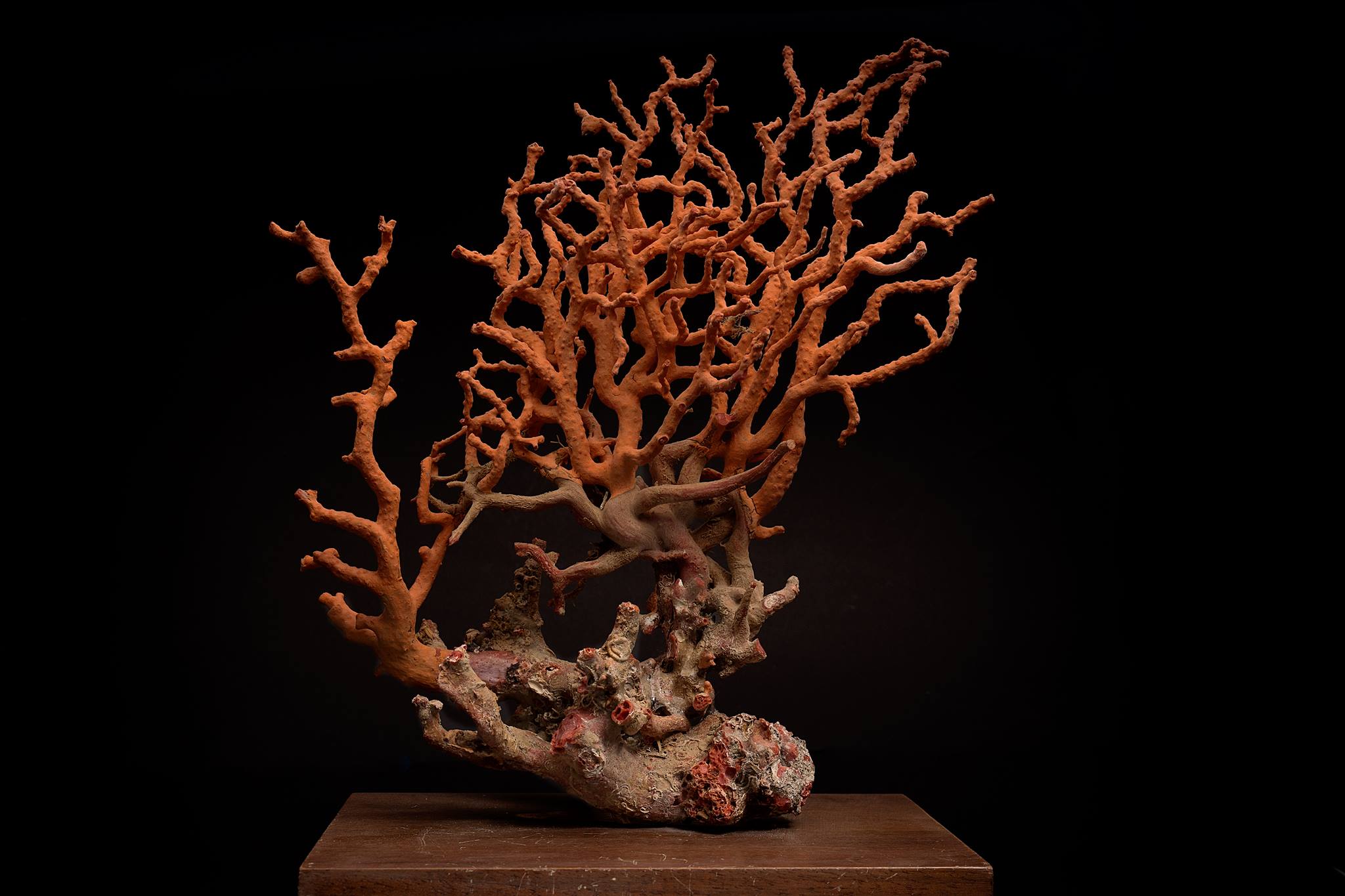

Since the dawn of the history, adornment that natural materials caused superlative impact in mankind, firstly the biogenic materials directly or indirectly associated with the hunting or collection of food and later the rocks and minerals that we today classify as gem materials.
From the biogenic sources, one particular material stood up not because it was a byproduct of food collecting, like pearls and shells as well as bone, ivory or feathers, but because it had a special colour, red, that has always been regarded in many cultured as the colour of life itself.
In the Mediterranean Sea as well as in the adjacent Atlantic, both in Spain and Portugal in the north and in Morrocco in the South, there is an indigenous species of coral, primarily composed of biomineralized calcite, that has a predominant red colour: the co-called Mediterranean coral, known among scientists as Corallium rubrum, defined as a species by Carl Gustav von Linné (1708–1778), known by its Latinized name Linnaus, in 1758. It was this very species with is many shades of red, from deep oxblood (very rare) to red, orangey-red, pink to light pink (also very rare) that captured the attention of fisherman and coastal communities, being incorporated, as very special gems, in adornments since at least the Neolithic period in Pre-History, but specially later during the Iron age.

The famous Greek naturalist Theophrastus (372-287 BCE) as well as the Roman naturalist Pliny, the Elder (23-79 CE) are very detailed in the mention of the use of this material and it’s origin, as well as its very fruitful trade with the Orient, being one of the most precious goods exported from West to the East in those historical times, and even today, in Indian tradition, red coral is regarded as one of the nine precious gems of the Navaratna, the most effective talisman representing the nine planets, where the coral is the planet Mars.

Even beyond India, coral tradition and cultural heritage is very well known in the Orient, including in Mongolia, Tibet Region and Bhutan, and in the Middle East in Yemen as well as in North Africa and specially in equatorial Africa, notably in the Kingdom of Benin. The interesting part of all of these ancient traditions and appreciation of red coral is the fact that the species is not indigenous to those places and had to be traded and transported from its actual origin, the Mediterranean Sea or nearby Atlantic Ocean.

In western culture, coral has also made significant impact, notably in classic mythology, with Metamorphoses, the famous work by Publius Ovidius Naso 43 BCE-17 CE, better known as Ovid, where the fantastic character Medusa, a mythical gorgon monster, that turned people into stone just by looking at them, was killed by an intelligent hero, Perseus, that used a mirror shield and a sharp sward to decapitate the monster. After burring her head in shore sand at the sea shore covering it with branches that hardened, mythical sea nymphs took them into the sea and transformed into coral. A fantastic non-scientific explanation of the origins of this precious gem material that still today lies the belief in its powers against poison, the evil eye, infertility and even epilepsy. The very popular metaphor in literature of good overcoming evil and the challenges of facing one’s most fearful fears, has been subliminally behind the many mentions of red coral in spiritual writings including the sacred scriptures in many religious beliefs.


More organized and systematic fishing of coral as a precious gem material started not before 3,000 years ago being hard to establish exactly when, but there are interesting archaeological evidences from the 6th century BCE in Marseille, France. Fishing continued for centuries using special apparatus to collect the branches from great depths, but modern regulations in the Mediterranean now only allow for scuba diving fishing bellow 50 meters in designated areas, a method that has been debated in the community due to the safety issues associated with diving to such depths. The old fishing technique that was discontinued in the late 20th century to protect the sea bed biodiversity used an apparatus called ingegno (because it was an ingenious solution), that consisted of a wooden cross holding a multitude of very long fishing nets, (up to 9 meters in length) that, after being dropped off board, was dragged upwards and across the sea bed and rocky substrate capturing the local coral branches.
Although we associate Mediterranean coral with the Naples bay and the nearby town of Torre del Greco in Italy, this red coral had many historical fishing and producing centres, including the Lagos in Portugal, Catalunya in Spain, Marseille in France, Trapani in Sicily, Genoa and Lehorn in Italy, Mersa el Kharez in Algeria) and Tabarka in Tunisia. It was the establishment of the Reale Compagnia del Corallo in Torre del Greco, Italy, in the 18th century that created the seeds for this world-renown craftsmanship and trading tradition. After it developed as “Reale Scuola di Incisione e Lavorazione del Corallo” (roughly translating as the Royal School for fashioning and engraving coral) numerous international artists, crafts masters and professors came from other coral manufacturing centres, like Trapani, Genoa and Marseile, to share their skills and knowledge to local artisans.

By the time official fishing activity for precious coral was reported in Asia, firstly in the Koshi area of Japan around the 1870s, and later in 1920s in Taiwan region, Torre del Greco was already a solid arts and crafts and trading centre for precious coral, has a heritage from the millennial-old fishing and fashioning tradition in the Mediterranean.

Once believed to be stony plants or hybrids between plants and animals, these colonial animals of the phylum Cnidaria known in the trade as Mediterranean or Sardinian coral, belong to a very specific family, Corallidae, that is, according to CIBJO – The World Jewellery Confederation, the only taxonomic group of corals that have precious corals that are used in high jewellery.
Current fishing regulations in the Mediterranean prevent any coral living above 50 meters deep to be fished by scupa divers (the only allowed fishing method) as well as any coral with a trunk diameter of less than 7 millimetres.
These terminology definitions clearly separate the collective term coral (thousands of species of marine invertebrates of the phylum cnidaria) from “precious corals” (those that are used in jewellery and decoration, specifically red, pink and white varieties with porcelain like lustre after polishing, limited to species belonging to the family Corallidae, including the Mediterranean species Corallium rubrum).
Understanding the terminology and the history and both cultural and artistic heritage is important to fully appreciate the tremendous cultural value of this biogenic gem material that has been embraced as a precious gem material for millennia and with world-wide reach despite its localized geographical origin in historical times.
This guest article will be printed in Gem Spectrum printed magazine Winter 2025/26 issue. Please stay tune for Flipbook.
Guest articles by Rui Galopim de Carvalho:
https://gem-spectrum.com/category/rui-galopim-de-carvalho

About the author:
Rui Galopim de Carvalho is a renowned independent Gem Education Consultant, author, luxury industry training expert and popular international lecturer on gemmology and on the history of gem materials. During his 30 year experience as a gemmologist, Rui has studied important collections in both public and private museums, notably the Portuguese Crown Jewels.
Founder of the popular Home Gemmology webinar series launched during the COVID-19 lockdown, Rui has a long history as a gemmology communicator, notably on social media where he is a popular figure.
He is associate editor of Gem-A’s Journal of Gemmology, Vice-President of the Coral Commission of The World Jewellery Confederation – CIBJO, member of the Communications Committee of ICA (International Colored Gemstone Association), ambassador for LAUREL -Portuguese Association of Excellence Brands (ECCIA member) and consultant for several private collections and trade organizations.
Rui Galopim de Carvalho can be reached through his website:
This article was published on Gem Spectrum print magazine issue #6 (Winter 2025-26), Page 28. Browse the flipbook here. Full-screen viewing and download are possible.