by Julius Zheng, GIA GG

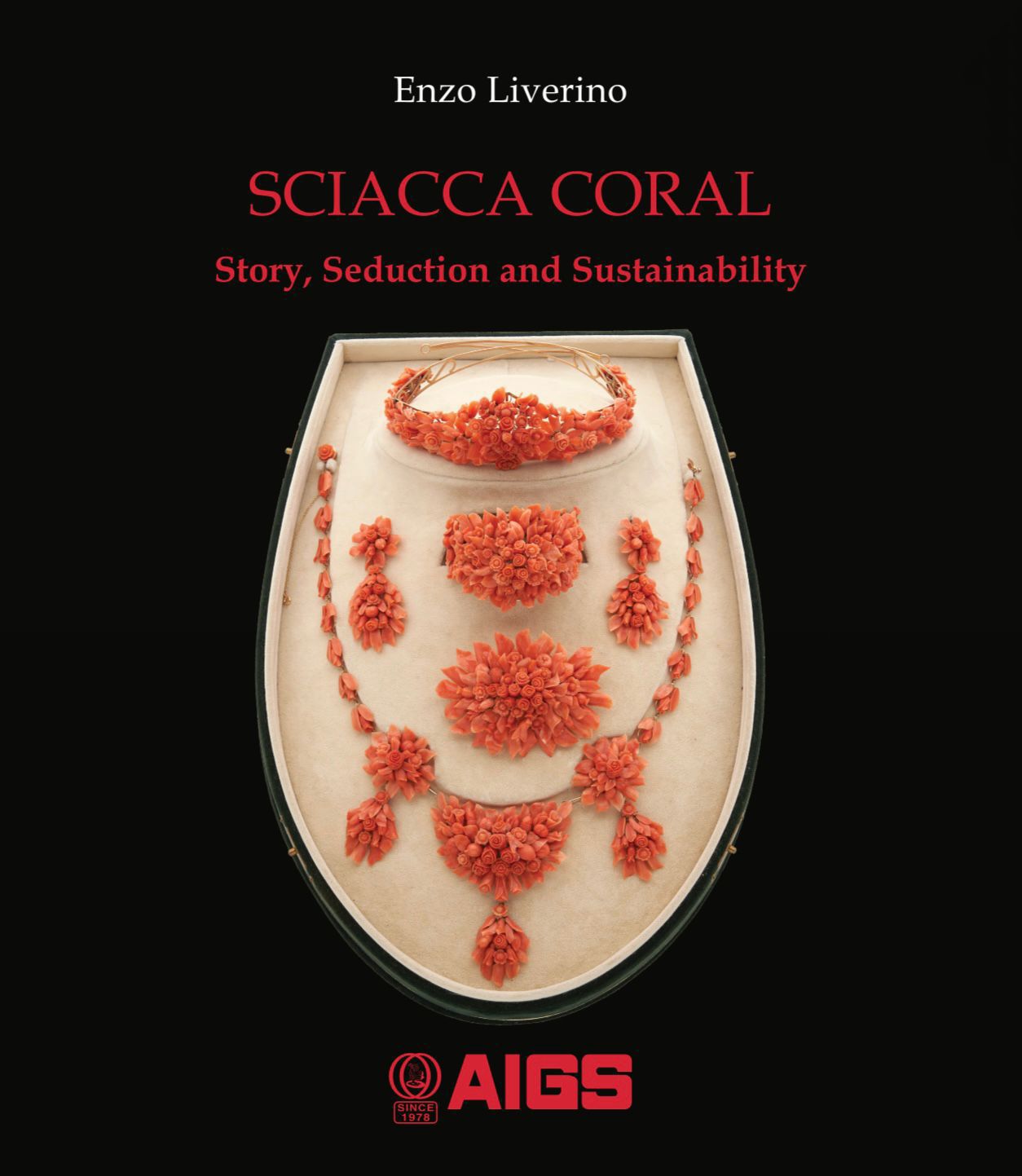
In the intricate tapestry of Mediterranean history and culture, few materials have managed to enchant and intrigue the human imagination quite like coral. The Mediterranean basin, a crossroads for countless civilizations over millennia, has always been rich in natural wonders. Yet even among these, coral stands apart. In his absorbing and meticulously researched book, Sciacca Coral, Enzo Liverino opens a gateway into the world of this storied material—a world in which the boundaries between nature, culture, trade, art, and the deepest dimensions of human longing are blurred and constantly redrawn.

Liverino’s work is not just an accessible survey or an academic treatise; it is an intimate portrait, a love letter, and a call to stewardship, all woven into a single narrative. Subtitled “the story, seduction, and sustainability,” the book traces the trajectory of Sciacca coral from its mysterious ancient origins to its ongoing cultural and economic significance. It is a text that rewards slow reading and reflection, generously offering its readers both knowledge and wisdom through an engaging range of stories, analysis, and personal testimony.
As Henry Ho, founder of Asian Institute of Gemological Sciences (AIGS) writes in the Introduction of the book, “It has been an honor to support the publication of this work. Enzo’s voice is generous, knowledgeable, and full of heart, and his legacy, much like the coral he so treasures, will endure for generations to come.”
A Material Woven Into Civilization: Historical Resonance

At the core of Sciacca Coral is an appreciation for how deeply this material is interlaced with the destinies of societies around the Mediterranean and beyond. The book delves into the earliest records of coral usage, rivaling even precious stones for value and symbolism. Ancient Egyptians, Greeks, Phoenicians, and Romans all attribute special meaning and power to coral—often as a protective amulet for children, as a guarantee of safe passage, or as a status symbol for those who could afford its beauty. The vivid red, branching forms were thought to carry a kind of natural magic, a power that transcended mere ornament.

Liverino presents the story of Sciacca coral’s emergence with the narrative flair of a historical novelist. He recounts the legend of Alberto Maniscalco, a fisherman whose accidental discovery of the coral beds off the coast of Sciacca in the late nineteenth century brought about a local economic renaissance. The tale is more than romantic—it foregrounds the material circumstances and personal fortunes that so often underlie shifts in economic and cultural history. The discovery of vast sub-fossil coral beds on the Sicilian seabed triggered a burst of industry, innovation, and cross-cultural exchange, endowing Sciacca with a significance that has persisted ever since.

One of the book’s strengths lies in how it situates Sciacca coral within the great trade networks of the world. Sicily, and Sciacca specifically, became a focal point not just for coral harvesting but for merchant diplomacy. As Liverino notes, “coral moved across borders and cultures, trading hands between Jewish, Arab, and Christian merchants, and taking on new meanings with every exchange.” It traversed the Silk Road, found destinations as far away as India and Japan, and was sometimes exchanged for gold, spices, or other precious substances.
Shamanic waistcoat from Tibet decorated with Mediterranean coral and other gem materials (e.g.turquoise, chalcedony dzi stone, shells), a good example of the global outreach of the coral trade in history.

Coral’s journey through history is not solely an account of commerce but of cross-cultural symbolism and exchange. The material appears in the inventory of Medieval European treasuries, in the turquoise-flecked jewelry of Central Asia, in Catholic rosary beads, and on the protective charms of Moroccan infants. The book includes fascinating glimpses into the social rituals and religious practices in which coral was worn, presented as gifts, or employed as a talisman against evil—demonstrating that the history of Sciacca coral is inseparable from the human quest for meaning and protection.
The Cultural and Economic Impact: A Living Heritage
To understand coral is to understand identity, and Liverino invites readers to see how Sciacca coral is entangled with the formation of individual and collective memory. This is perhaps most beautifully rendered in the author’s own family stories. The story of Carmela’s necklace, for example, bridges the personal and the historical. For Liverino, his grandmother’s coral jewelry is a source of reminiscence and pride—and an impetus to explore why such objects are revered. As readers, we are reminded how inherited objects become sacred not for their material value alone, but for their connection to the loves, hopes, and fears of those who came before us.
Economically, the impact of Sciacca coral can scarcely be overstated. Liverino describes the formation of artisanal guilds, the rise and fall of local fortunes, and the influence of coral on regional employment and gender roles. Women played a key part in the processing and stringing of coral beads, sometimes working from home, and children were often introduced to the trade at a young age. Guild records and oral traditions track the integration of coral into festivals, dowries, and inheritance rituals—cementing its place in the collective life of Mediterranean societies.
The book also addresses broader economic questions regarding the international coral trade, periods of boom and bust, the exploitation and regulation of coral fisheries, and the long-standing competition among Italian, French, and North African producers. Liverino documents the ways governments sought to control or tax the trade, shaping both the legality and the fortunes of coral merchants throughout the centuries. These details illuminate a wider context: Sciacca coral, like oil or salt, is a natural resource that has sparked not only artistic innovation but also disputes, regulations, and technological advancements over generations.
Sustainability: Honoring Nature, Traditions, and Future Generations
One of the defining contributions of Sciacca Coral is its nuanced examination of sustainability—a subject too often overlooked in discussions of luxury and heritage materials. Liverino’s attention to the geological origins of Sciacca coral sets the stage for a thoughtful analysis of responsible resource management. Unlike coral harvested from living reefs, Sciacca coral is extracted from ancient sub-fossil beds—a crucial distinction that allows for its procurement with minimal ecological disruption, provided it is done responsibly.
The author is forthright in confronting the modern environmental crisis and the role of traditional industries within it. He interviews stakeholders from throughout the value chain: fishermen navigating shifting regulations, artisans struggling to maintain economic viability in the face of global competition, and scientists seeking to monitor and restore marine ecosystems. These diverse perspectives are woven together with scientific data on coral formation and regeneration. References to contemporary marine biology and climate science frame the entire discussion, underscoring the intertwined fate of nature and culture.
Liverino’s treatment of sustainability is especially persuasive because it is practical, not merely philosophical. He highlights successful models for monitoring coral populations and controlling extraction. Importantly, he situates the responsible harvesting and processing of Sciacca coral within broader global conversations about sustainable luxury, fair trade, and environmental ethics. The most passionate collectors and artisans, he argues, are often the strongest advocates for conservation, since their livelihoods depend on a healthy relationship between industry and ecology.
Sciacca Coral goes further, exploring how the lessons drawn from coral can be generalized to other fields: “The responsible use of natural resources is not a restraint on creativity,” Liverino writes, “but a precondition for true, lasting beauty.” Here, the text becomes almost a manifesto, suggesting that sustainability can enhance, rather than limit, the meaning and enjoyment of precious goods. This is an important point for contemporary readers grappling with the urgent question of how to balance heritage and innovation, tradition and change.
Artistic Connections: From Sacred Amulets to Contemporary Sculpture
Coral has always been an object of fascination for artists, crossing the boundaries of jewelry, sacred art, and avant-garde experimentation. Throughout his book, Liverino brings alive this artistic journey. Ancient objects—amulets, reliquaries, crowns—are rendered in vivid detail, their surfaces gleaming red with the touch of time and reverence. Artisans in Sciacca and Naples refined their techniques through centuries, creating pieces that blended science with myth and faith with fashion.
The book devotes special consideration to coral’s continued influence in modern and contemporary art. Liverino illuminates how great Italian jewelry houses have built global reputations on their mastery of coral, transforming the raw material into wearable works of art. He also explores collaborations between traditional artisans and innovative designers who have brought coral into galleries and museums around the world.
The chapter on Jan Fabre’s sculptures, especially The Purity of Mercy and The Resurrection of Life in Naples, is one of the book’s highlights. Fabre’s art fuses religious and mythological imagery, embedding coral in a dialogue with themes of suffering, transformation, and redemption. Liverino’s analysis demonstrates that coral is far from a static historical relic. Instead, it lives and breathes within contemporary imagination—its sacred aura continually reinterpreted and renewed.
Quoting one of the book’s memorable passages: “Coral has turned out to be so much more than just something beautiful. It’s been travelling with humans for thousands of years, carrying our beliefs about protection and beauty and what’s sacred.” This perspective enriches our understanding of the enduring power of materials that appear simple, yet are endowed with generations of memory and creativity.

Broader Implications: Memory, Identity, and the Moral Economy
Sciacca Coral ultimately invites readers to reflect on the relationships that make up the fabric of tradition. Every necklace or carved icon, every bead strung by hand, is a testament to connections—familial, cultural, and spiritual. For Liverino, coral is both an inheritance and a responsibility. The author’s candid acknowledgment of his personal “bias”—his family’s centuries-old involvement in the coral trade—becomes a strength, not a weakness. It lends the narrative not only authority but also humility and openness to debate.
The book engages with pressing contemporary debates around the protection of cultural heritage and the dangers of commodification. Liverino warns of opportunistic exploitation—driven by fashion or profit alone—that threatens both environmental sustainability and cultural meaning. In contrast, he advocates for an approach rooted in reverence: one that treats coral not as a mere commodity, but as a catalyst for preserving memory, affirming identity, and transmitting values across generations.
In this way, Sciacca Coral is a book as much about people as about its eponymous subject. The stories of mothers passing down coral rosaries or necklaces to daughters, of scientists striving to understand marine life, of artisans defending their crafts in a globalized world—all are reminders that material objects are intertwined with intangible legacies. The book stands as a call for thoughtful stewardship, not only of nature’s gifts, but of the wisdom, rituals, and stories we inherit.
Organization and Readability
From a reader’s perspective, Sciacca Coral is inviting and well-structured. The book opens with a poetic meditation on coral’s allure, moves through clearly organized thematic chapters, and finally draws together the threads of history, science, and personal narrative. The clarity of Liverino’s prose ensures the book is accessible both to experts and to general readers, while detailed endnotes and suggested further readings encourage continued exploration.
The author succeeds in balancing scholarly rigor with narrative accessibility. Anecdotal asides and illustrative case studies animate the text, enlivening legal documents, trade records, and scientific reports. The inclusion of photographs and artistic reproductions—though referenced more than included due to format—also helps readers visualize the objects under discussion. Ultimately, Liverino’s passionate tone makes the book as engaging as it is informative.
A Book for Scholars, Makers, and Dreamers Alike
Sciacca Coral will immediately find its audience among scholars of history, art, marine science, and Mediterranean studies. However, it will also appeal to a much broader public: jewelry lovers, sustainability advocates, descendants of those who worked in or traded coral, and anyone open to being transported by a well-told story.
The book’s arguments are consistently well-supported, combining archival research, scientific context, and personal evidence, and Liverino encourages even readers who are initially skeptical to reflect on why certain materials acquire lasting cultural power. He asks, “Why were peoples so far from the Mediterranean, where coral is harvested, so drawn to this material that they’d exchange it for equally precious goods?” The search for an answer is both the subject and the intellectual delight of the book.

Final Reflections: Stewardship and the Future
If there is a lasting lesson in Sciacca Coral, it is that the most precious things in our world—whether natural treasures or cultural traditions—demand both passion and care. Enzo Liverino’s work is not only a celebration of a remarkable material, but also an appeal to future generations to treasure, protect, and reimagine what we inherit.
The closing chapters remain with the reader long after the book is finished. Through coral, we are prompted to reconsider our relationships with the natural world and with each other. The fields of sustainability, art, history, and even economics are shown not to be discrete domains, but overlapping realms, each enriched by the insights and values of the others.
As Liverino so beautifully demonstrates through stories like Carmela’s necklace and Fabre’s sculptures, Sciacca coral is more than a relic of the past. It is a living medium, a symbol of memory and hope, a red thread linking generations. In the author’s words: “You cannot change the story … or maybe can … why not …” It is an open invitation—for discovery, connection, and renewal.
Sciacca Coral is not just a book to read, but one to return to, to ponder, and to share. For anyone drawn to the intersections of art, history, culture, and ecology, it offers a rare and dazzling journey.

This book review was published on Gem Spectrum print magazine issue #7 (Spring 2026), Page 26-31. Browse the Flipbook here. Full-screen viewing and download are possible.