Guest article by Daniel Nyfeler, PhD – Managing Director, Gübelin Gem Lab Ltd. & Provenance Proof Ltd.

For decades, the gemstone and jewellery trade has relied on an implicit trust system: relationships, reputation, and paperwork have carried value across borders and across generations of businesses. That model is increasingly under strain. Today, the industry faces a different set of expectations, shaped by regulation, by corporate due diligence standards, and by a consumer culture that expects to know not only what a product is, but where it comes from and under what conditions it was produced.

In this environment, traceability is no longer a nice-to-have. It is becoming a structural requirement for coloured gemstones, diamonds, and jewellery. But the industry is also learning a more subtle lesson: traceability is not the same as documentation. A paper trail can be complete and still fail to prove that the object in a jewellery piece is the same object that was documented at the start of the chain. The challenge is to connect physical reality and digital information in a way that remains robust even when goods are cut, mixed, subdivided, transported, and exchanged multiple times.
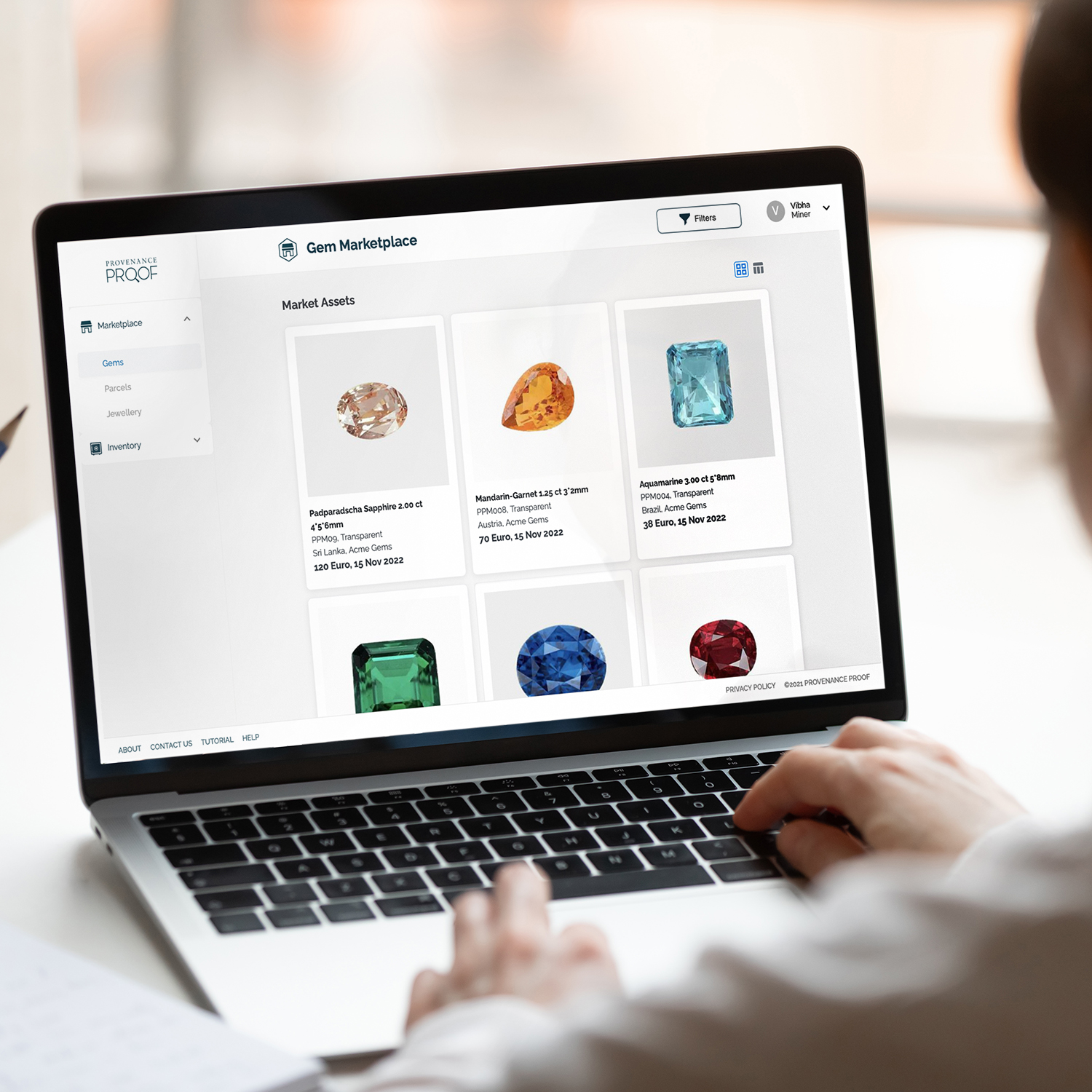
This is where Provenance Proof has established itself as one of the most consequential traceability infrastructures in the sector. Its relevance lies not in creating a new narrative of transparency, but in providing the tools to make transparency verifiable, at scale, and in a complex, multi-actor trade where transactions frequently occur between parties that do not fully trust one another.
The Hard Truth: Documents Track Paper, Not Material

Most supply chains are tracked through certificates, invoices, export papers, internal databases, and compliance files. Such tools are essential, but they share a fundamental weakness: they track information, not the material itself.
The moment a gemstone is taken out of a controlled parcel, re-assigned to a different batch, re-cut or re-polished, the risk of identity drift emerges. A digital record may continue to exist, but the link to the actual physical stone becomes vulnerable. This is not only a theoretical problem, it becomes acute in the real economy of gemstones, where sorting, treatment, re-export and re-selling are common, and where parts of the chain remain informal.

The problem is even more severe for diamonds, and especially for melee diamonds, which are processed in high volumes and routinely aggregated, mixed, and re-sorted. Here, traditional traceability becomes almost impossible if it depends only on documentation. A credible traceability system must therefore answer two separate tasks:
- To identify the material itself as having originated from a specific source or batch
- To record and verify the chain of custody and transformations over time
Provenance Proof’s significance is that it explicitly addresses both, by combining physical tracers and blockchain-secured digital tracking, two technologies that are often discussed separately but in practice complement each other almost perfectly.
Putting Origin into the Stone: Synthetic DNA as a Physical Tracer
The physical tracer system deployed by Provenance Proof uses synthetic DNA fragments as information carriers. Metadata such as mine site, mining company, extraction period, or other attributes is encoded directly into a DNA sequence. This DNA is then encapsulated in amorphous silica nanospheres, creating a protective carrier designed to resist environmental and chemical stressors such as humidity, heat, and sunlight.
The concept is elegant in its simplicity: instead of relying exclusively on what people claim about a stone, the identity information becomes physically attached to the object. The tracer particles are extremely small (around 100 nanometres, or 0,0001 millimeters) and therefore invisible to the naked eye and even the most powerful optical microscope. It can only be made visible by Scanning Electron Microscopy.

Applied through controlled immersion protocols, the technology is designed to be compatible with industrial-scale operations, an essential requirement to become a systemic infrastructure.
Verification is performed analytically, using quantitative PCR (qPCR) to detect and read the DNA signature. This is not a forensic origin determination method as applied by traditional gem labs in the classical gemmological sense, where inclusions, chemistry, or spectroscopy are used to infer origin. Instead, it is a deliberate, controlled identity layer: a purpose-built marker that can be tested and validated at later points in the supply chain.


Recording What Happened: Digital Tracking and Blockchain Integrity
Physical tracers establish what the material is. But traceability is also about what happens over time, i.e. who handled the stone, what transformations occurred, and when custody changed. That is the role of Provenance Proof’s digital tracking system.
In such systems, the central requirement is tamper resistance. In an industry where actors often do not fully trust each other, and where transactions can happen outside formal structures, the traceability ledger must resist silent edits and retroactive manipulation.
This is where blockchain architectures become meaningful—not because they magically produce truth, but because they provide integrity. Blockchain does not guarantee that entered data is correct. It guarantees that once recorded, it becomes quasi impossible to change without detection. For audit-driven industries, that is precisely the point: traceability must withstand scrutiny, including when disputes occur.
Provenance Proof positions blockchain not as a branding term, but as one layer within a broader governance system. Actors in the chain record events; the system structures and links these events; and the blockchain ledger anchors them so that auditors can confirm chronological continuity and detect tampering.
Why the Combination Works: Closing the Physical–Digital Gap
The real strength of Provenance Proof is that it does not treat physical tracing and digital tracking as alternative philosophies. It treats them as complementary technologies.
- Physical tracers without a digital chain tell you where something came from, but not what happened to it later.
- Digital tracking without physical anchors can produce detailed histories, yet remains vulnerable to substitution, mixing and identity drift.
When combined, they solve each other’s weaknesses:
- The tracer provides a persistent identity reference that can be checked at critical points in the chain.
- The blockchain-backed digital record provides the time-ordered history that gives that identity meaning.
The result is a traceability system that is more than a compliance tool, it becomes a mechanism to reduce fraud risk, strengthen due diligence, and support credible responsible sourcing claims in both gemstones and diamonds.

From Coloured Gems to Melee Diamonds: Scaling into the Diamond Industry
Since 2017, Provenance Proof technologies have been adopted by over 700 companies, mainly in the coloured gemstone sector. Over that period, more than 40 million gemstones have been uploaded to the Provenance Proof blockchain, establishing it as the de facto global standard for traceable coloured gemstones.
However, one of the most notable recent developments is its growing role in diamonds—particularly through the large-scale deployment of physical tracers on melee diamonds. Two major diamond manufacturers, KGK and Diarough, are now using Provenance Proof’s physical tracers at scale on melee production.
This matters because melee is where traceability typically breaks down. High throughput, constant mixing, and batch reconfiguration make it extremely difficult to maintain object-level identity. The ability to tag and later verify melee diamonds demonstrates that physical tracing can function in industrial diamond manufacturing environments and not only in smaller-scale coloured gemstone contexts.
For the jewellery industry, this signals something larger: traceability solutions are moving from niche initiatives to scalable systems capable of addressing the volume realities of modern production.
What Comes Next: From Trust-Based Narratives to Verification-Based Provenance
As sustainability, responsible sourcing, and due diligence requirements become embedded in procurement practices, the trade will increasingly need traceability infrastructures that are interoperable, scalable, and technically credible.
Provenance Proof’s contribution is not a promise of transparency. It is the creation of a framework that makes provenance testable, auditable, and resilient in a fragmented global value chain.
The broader implication is that the industry may be approaching a shift similar to what happened in other regulated sectors: moving from “trust-based narratives” to verification-based provenance. In an environment shaped by competing claims and growing scrutiny, that shift may become one of the defining evolutions of the next decade.
Articles about Gübelin Gem Lab Ltd. & Provenance Proof Ltd.:
https://gem-spectrum.com/tag/gubelin
Articles about gem labs:
https://gem-spectrum.com/tag/gem-lab
Articles about Traceability:
https://gem-spectrum.com/tag/traceability
This article was published on Gem Spectrum print magazine issue #6 (Winter 2025-26), Page 17. Browse the Flipbook here. Full-screen viewing and download are possible.