
Save the date for GEMGENÈVE 2026: May 7-10 at Palexpo.

GemGenè̀ve’s cultural and educational ethos contributes to the event’s legitimacy, identity and longevity. In a world where everything moves fast, creating meaningful spaces where knowledge can be passed on is a real responsibility. – Mathieu Dekeukelaire, director, GemGenève
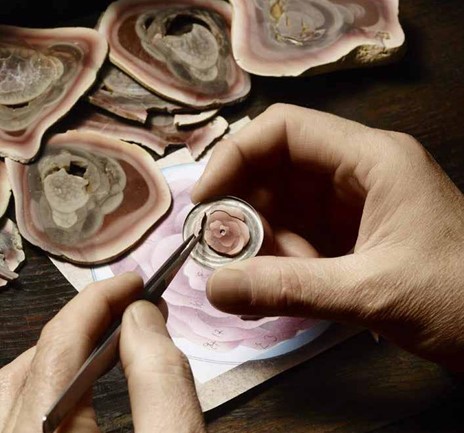
For its eighth on-site exhibition from 7 to 10 May this year, GemGenève has come up with an innovative offering that explores the very essence of artistic creation – the powerful and fragile instant at which the human hand and raw materials interact. Shaping matter, enhancing beauty offers insights into handicrafts, celebrating the transitioning of material from its raw state into precious artefacts.
>>THE HUMAN TOUCH AT THE HEART OF THE LATEST EXHIBITION SHAPING MATTER, ENHANCING BEAUTY
From cutting and polishing to engraving and carving, a crucial encounter lies behind every jewel and objet d’art at the point where the artisan’s hand meets the material itself. This original GemGenèveexhibition sheds light on the unspoken dialogue between mineral and organic matter and the hand that shapes it. Every single gesture is not only technically precise: it is also a decisive stage in the birth of an item of jewellery or work of art. Combining technique, tradition, experience and intuition, this dexterity embodies knowhow that is hard to put into words – but no less praiseworthy for all that.
Devised by Mathieu Dekeukelaire with the support of the Baur Foundation, the Museum of Far Eastern Art and the Geneva Museum of Art and History (MAH), the exhibition brings together over one hundred items loaned from institutional and private collections. Pauline d’Abrigeon and Estelle Fallet, curators at the Baur Foundation and MAH Geneva respectively, have pooled their expertise for GemGenève to co-curate its latest cultural event and make this ambitious project a reality.
From cameos to nephrite vases from the Qing dynasty via intaglio prints and Art Deco né́cessaires, the exhibition offers a broad and eclectic overview of the extraordinary diversity of materials used in handicrafts through the ages. Featuring jade, horn, onyx, agate, coral and amber, Shaping matter, enhancing beauty offers a deep dive into the world of rare mineral and organic materials – most of thelatter now covered by strict legislation due to their links with protected species.
Alongside the exhibition itself, Pauline d’Abrigeon will be sharing her knowledge and insights during a dedicated panel discussion, giving the general public an in-depth perspective on the works of art on display.

>> THE BAUR FOUNDATION’S MUSEUM OF FAR EASTERN ART COMES TO GEMGENÈVE FROM IMPERIAL JADE TO JASPER SNUFF BOXES, NEARLY TWO SCORE ITEMS
FROM THE MUSEUM FEATURE IN THIS OFF-SITE EXHIBITION
Our desire to promote the wealth of materials and decorative techniques for which our collection is renowned and reconnect with connoisseurs and friends of the museum naturally encouraged us to be present at GemGenè̀ve this year. At a time when the Baur Foundation’s premises are closed, this event in Geneva with a strong emphasis on exceptional craftsmanship offers a chance to display some of our works in a space that makes sense for us. – Laure Schwartz-Arenales, Baur Foundation director and general curator, Museum of Far Eastern Art

The Baur Foundation’s Museum of Far Eastern Art has been closed for renovations since August 2025 – but is getting ready to write a new chapter in its history in just a few months’ time. Ahead of the museum’s reopening, GemGenève has invited the Foundation to come to Palexpo and stage an off-site exhibition – a unique opportunity to admire some of the finest pieces from its collection. Almost forty objets d’art belonging to the private foundation will be on show at Shaping matter, enhancing beauty – a fitting way to share the treasuresof this Geneva institution with GemGenève visitors and exhibitors alike.
Located in Geneva in a mansion dating from the late nineteenth century, the Baur Foundation is home to one of Europe’s most remarkable collections of Chinese and Japanese art. Jades, porcelain, lacquer furniture, engravings, netsuke and sabre decorations are among the nine thousand or so artefacts amassed by Swiss collector Alfred Baur (1865-1951), including one of Europe’s largest collections of Chinese porcelain – and some items produced by the Imperial manufactories. Since 1995 the museum has also benefited from several
gifts, in particular of antique Chinese lacquer furniture, Chinese export porcelain, Chinese and Japanese fabrics and a large collection focusing on the Japanese tea ceremony. The Baur Foundation is the only museum in Switzerland solely devoted to far eastern art and also hosts temporary exhibitions several times a year.
>> THREE QUESTIONS TO PAULINE D’ABRIGEON
CURATOR OF CHINESE COLLECTIONS, BAUR FOUNDATION AND EXHIBITION CURATOR
What materials were you keen to highlight and why?
Given the fact that gemstones are at the heart of this event, our thoughts went first to the Baur collection of jades – they make up the largest share of the loan, accounting for over half of the works on display. Jades are also the inspiration for the exhibition’s title Shaping matter, enhancing beauty: jade is an exceptionally hard gemstone, calling for painstaking abrasion of the surface to allow decorations and distinctive shapes to emerge. From this central theme we’ve extended our selection to include artefacts made using a variety of materials such as coral, ivory and agate, all highlighting the dialogue between the raw materials and human hands.
What are the most spectacular pieces you’ve chosen for display at GemGenève?
Shaping matter, enhancing beauty is an opportunity to present exceptional items produced in the Imperial workshops, revealing the tastes of Emperor Qianlong (who reigned from 1736 to 1795) for translucent white jades – and intellectual culture. An especially fine bowl whose entire surface is decorated with floral patterns is a perfect example of the expertise of these workshops, as is a brush pot carved out of a single piece of jade whose decorations, akin to a painting, are an invitation to explore the garden of Chinese man of letters and calligrapher Wang Xizhi 王羲之, (321-379 or 303-361).
What were your criteria for selecting the jades that will be on show at GemGenève?
We chose pieces featuring a wide range of colours, allowing visitors to appreciate this material’s extraordinary diversity of hues, ranging from milky white to so-called ‘spinach’ jade recovered from the shores of Lake Baikal before being worked on in China.