by AGTA
From Washington to Bangkok to CIBJO in Vicenza, the American Gem Trade Association is expanding its efforts to influence trade policy, tariff negotiations, and industry standards affecting the colored gemstone sector.
The American Gem Trade Association (AGTA) has spent much of the past year making sure the United States jewelry industry has a voice wherever trade policy is being shaped—whether that means sitting down with lawmakers in Washington, meeting directly with foreign governments, or addressing an international audience of jewelry organizations and companies.
That effort was on full display in September, when AGTA President Bruce Bridges and CEO John W. Ford, Sr. traveled to Bangkok for an official meeting with senior officials of the Royal Thai Government. The meeting centered on ongoing bilateral trade negotiations between the United States and Thailand and AGTA’s push for a swift conclusion to the U.S.–Thailand Agreement on Reciprocal Trade.

Thailand is a key sourcing and processing country for AGTA members, making the status of the negotiations especially important to the U.S. jewelry industry. During the 74th Bangkok Gems & Jewelry Fair, held Sept. 8–12, AGTA met with members of Thailand’s gem and jewelry industry to discuss the negotiations and help inform the input they would provide to their government. Bridges and Ford also held separate meetings with Thai industry leaders and government officials, including Nisabudh Virabutr, director of the Lifestyle Trade Promotion Office within the Ministry of Commerce’s Department of International Trade Promotion.

On Sept. 14, the AGTA leaders attended a private meeting at Thailand’s Ministry of Commerce with Dr. Kirida Bhaopichitr, vice minister for commerce, and a large delegation of senior Thai officials. AGTA outlined its concerns about the status of the U.S.–Thailand negotiations and the potential risks to the Thai gem and jewelry supply chain if an agreement were not reached quickly. Bridges and Ford then fielded questions from Bhaopichitr and representatives of several Thai government departments.


AGTA described the discussion as extremely productive and shared details of the meeting with the Office of the U.S. Trade Representative (USTR). Following the trip, Bridges and Ford expressed optimism that the meeting could help move a U.S.–Thailand agreement forward, while also thanking Thai government officials and leaders of the country’s gem and jewelry industry for their cooperation.

The Bangkok visit was not an isolated effort. Just days earlier, at the 2026 Congress of CIBJO, the World Jewellery Confederation, in Vicenza, Italy, Bridges and Ford had laid out the larger advocacy campaign AGTA has built in response to U.S. import tariffs affecting loose colored gemstones, diamonds, and pearls.
Tariffs imposed beginning in April 2025 disrupted a trade that had long relied on duty-free imports into the United States. For the colored gemstone industry, the issue is particularly acute because the vast majority of materials AGTA members work with are not geologically available in the United States. Imports are not simply one part of the business; they are essential to it.
AGTA’s response has been to establish a full-time Washington operation and pursue what Ford described as an “all-of-government approach.” The association now works with three lobbyists, a trade attorney, a policy adviser, and a trade specialist, while engaging lawmakers in both chambers of Congress as well as officials from USTR, the White House, Commerce, Treasury, and other agencies.
The commitment has required significant face time. Bridges told the CIBJO audience that he and Ford had spent about 43 days in Washington over 14 trips since the tariff issue began, meeting with more than 32 members of the House and more than six senators, in addition to federal officials. AGTA has also sought to explain how tariffs affect an industry made up not only of large companies, but also of independent dealers, jewelers, manufacturers, and other small and midsize businesses.

That outreach has helped create new avenues for industry input. Bridges was appointed to a four-year term on USTR’s Trade Advisory Committee on Africa, which advises on U.S. trade and development policy involving sub-Saharan Africa. For a trade deeply connected to African gemstone production, the appointment gives the colored gemstone sector a direct channel into conversations that can affect the industry from mine to market.
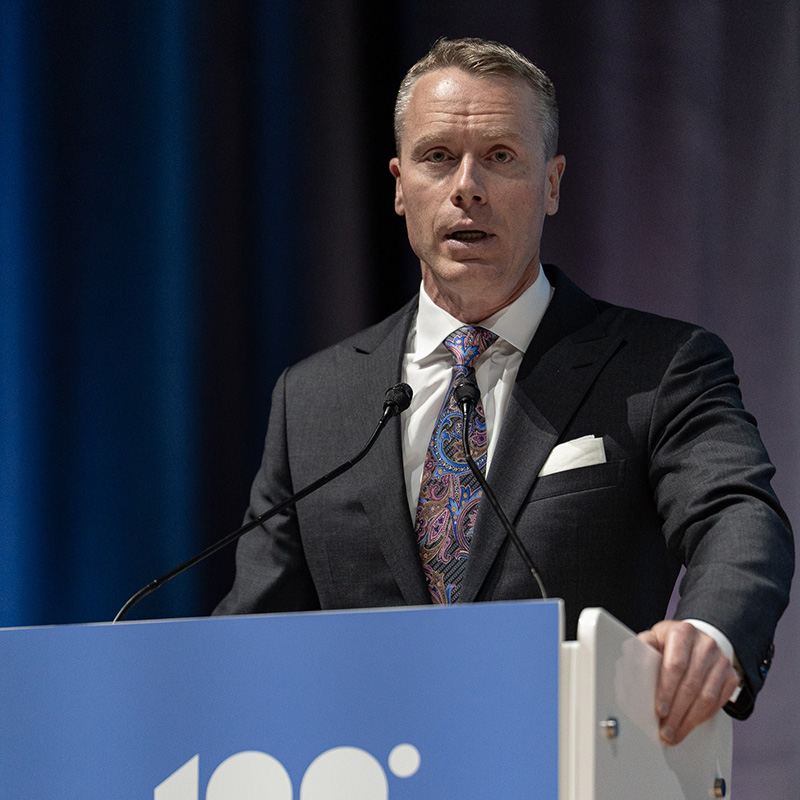
AGTA’s international outreach reflects the same strategy. At CIBJO’s centenary Congress, Bridges and Ford used a session on geopolitics and the jewelry industry to explain the association’s tariff efforts to an international audience. “Our industry is global by nature,” Bridges said, noting that gemstones and jewelry sold in the United States move through supply chains that cross multiple countries.

Thailand offered a particularly concrete example of that global interdependence. The Bangkok meetings allowed AGTA to work not only from the U.S. side of the negotiating table, but also with a major sourcing and processing country whose own industry has a stake in the outcome. The association’s decision to bring its concerns directly to Thai officials—and then relay the discussion back to USTR—underscored its increasingly international approach to advocacy.

Trade, however, was not the only policy issue AGTA brought to CIBJO. At the end of the presentation, Ford made a formal statement calling on the Federal Trade Commission to reconsider its 2018 Jewelry Guides revisions concerning synthetic diamonds.

In 2018, the FTC removed the word “natural” from its definition of diamond and permitted terms including “laboratory-grown” and “laboratory-created” to indicate a diamond that is not mined. AGTA wants the agency to revisit that framework during its next review of the Jewelry Guides, arguing that “synthetic” provides a clearer distinction between naturally occurring and manufactured gemstone products.
The issue also resonated with the international audience in Vicenza. Following the 2026 Congress, CIBJO’s board approved a recommendation that its Blue Books be revised so that “synthetic” would serve as the sole descriptor for created products with the same chemical composition, physical properties, and structure as their natural counterparts, while recognizing that national laws and regulations take precedence.
To Bridges, the tariff and terminology efforts are connected by a common responsibility: advocacy. Whether AGTA is meeting with the Royal Thai Government, speaking to U.S. lawmakers and trade officials, or addressing the international jewelry community at CIBJO, the aim is to make sure the industry is part of the conversation before policy is set.
As Bridges put it at CIBJO, “AGTA needs to be in the room.”
Appendix:
At CIBJO’s centenary Congress in Vicenza, AGTA detailed its fight against U.S. import tariffs affecting colored gemstones, Diamonds, and Pearls, highlighted Bruce Bridges’ new role advising U.S. trade officials, and issued a formal call for clearer terminology around synthetic Diamonds. Click here to watch the AGTA presentation from CIBJO.
Articles about The American Gem Trade Association, or AGTA:
https://gem-spectrum.com/tag/agta
Articles about CIBJO:
https://gem-spectrum.com/tag/cibjo
Articles about USA:
https://gem-spectrum.com/tag/usa