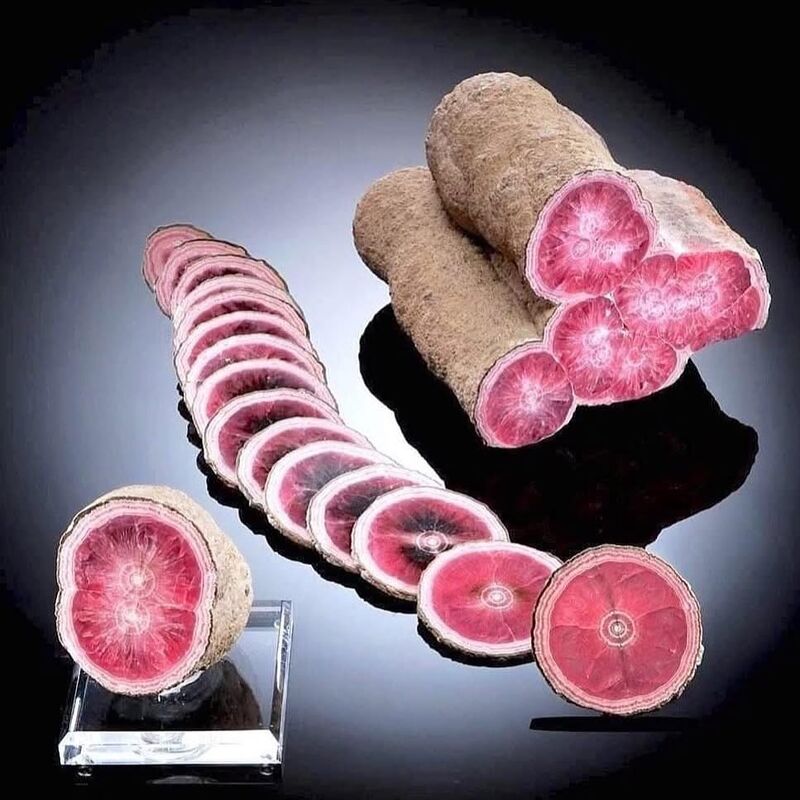

Salami, bacon or candy? None of the above! It is one of the most popular and attractive banded gem minerals: rhodochrosite, a manganese carbonate, a member of the calcite group, famous for these pink banded specimens that formed as stalactites when manganese- and carbonate-rich dropping fluids precipitated over long periods of time.
Often polished in round slices, revealing the concentric growth structure, these typically come from the Capilitas mine in Catamarca, Argentina, where they are often known as “inca rose”. Rhodochrosite also occurs as facetable gems notably in Colorado, USA, at the Sweet Home mine, in China (Wudong mine in Guangxi) and in the Kalahari, South Africa.

In spite of their beauty, transparent cut stones are not meant for the jewellery industry due to the mineral’s low hardness (between 3 1/2 and 4 in the Mohs scale), being instead a rather popular collectors’ stone for connoisseurs.
The mineral name, since 1813, is a typical case of classic nomenclature, from the Greek “rhodon” pink, and “chrosis”, color.

Photos. Rhodochrosite slices from Capilitas © Heritage Auctions; a splendid rhombohedral crystal cluster of rhodochrosite and an unusually large 92 carat cut stone from the Sweet Home mine, Colorado, USA. Photo © Jeff Scovil
Guest articles by Rui Galopim de Carvalho:


https://gem-spectrum.com/category/rui-galopim-de-carvalho

About the author:
Rui Galopim de Carvalho is a renowned independent Gem Education Consultant, author, luxury industry training expert and popular international lecturer on gemmology and on the history of gem materials. During his 30 year experience as a gemmologist, Rui has studied important collections in both public and private museums, notably the Portuguese Crown Jewels.
Founder of the popular Home Gemmology webinar series launched during the COVID-19 lockdown, Rui has a long history as a gemmology communicator, notably on social media where he is a popular figure.
Rui Galopim de Carvalho can be reached through his website: