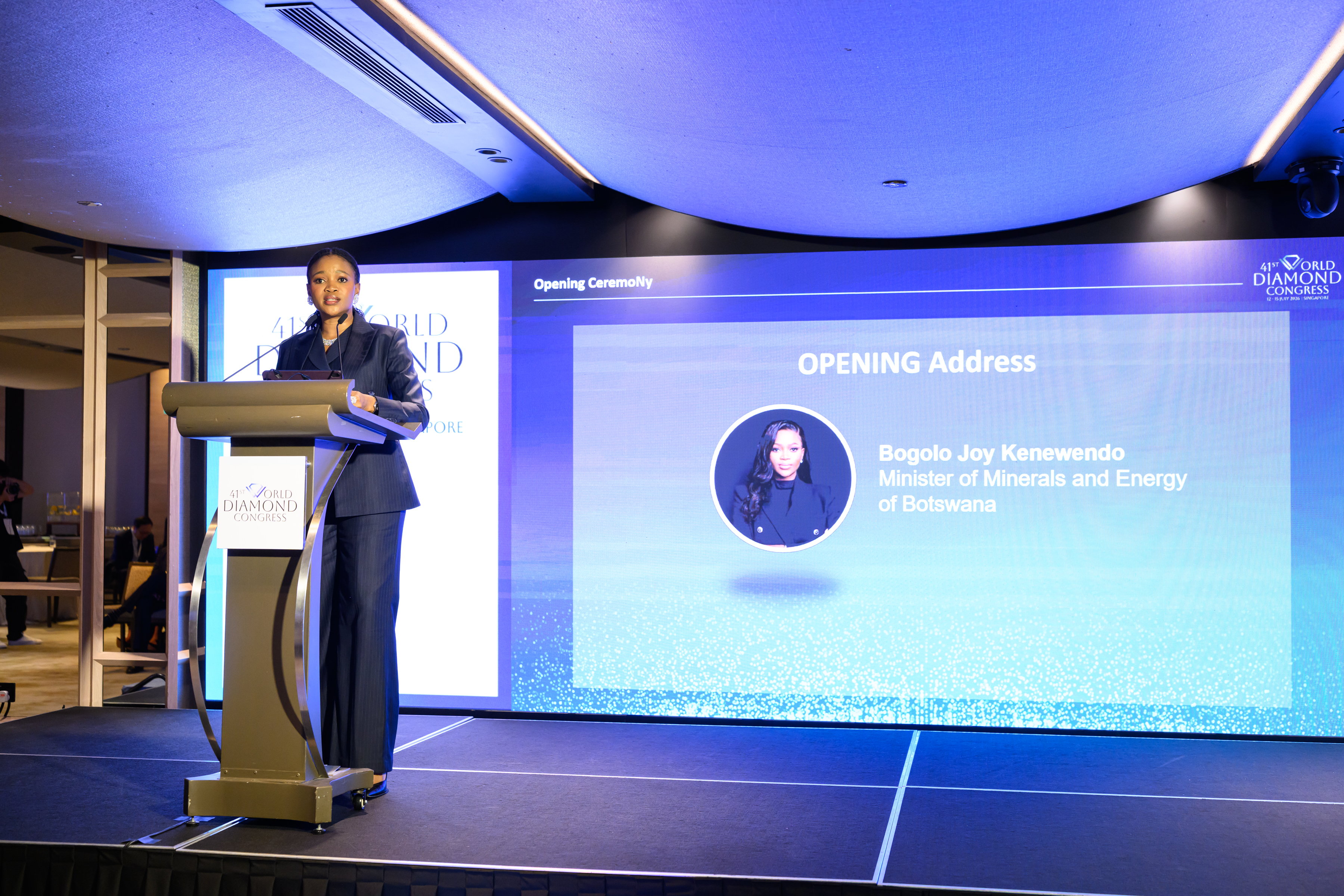


President of the World Federation of Diamond Bourses,
President of the International Diamond Manufacturers Association,

Distinguished Industry Leaders,
Excellencies,
Ladies and Gentlemen,

It is a great honour to join you in Singapore for the 41st World Diamond Congress. I wish to thank the World Federation of Diamond Bourses and the International Diamond Manufacturers Association for bringing together leaders from across the global diamond value chain at a time when our industry finds itself reflecting not only on its achievements, but also on its future.
The diamond industry has never been static. Throughout its history it has adapted to economic cycles, geopolitical shifts, technological advances and changing consumer tastes. Yet there are moments when change feels more profound than usual, when it challenges not simply how we operate, but how we think about ourselves. I believe we are living through one of those moments today.

Across our industry there is a growing conversation about demand, about the rise of synthetics, about traceability, sustainability and consumer confidence. These are important discussions, and rightly so. However, I sometimes wonder whether we are framing the challenge too narrowly.
We often ask whether consumers can distinguish between a natural diamond and a synthetic. Perhaps the more important question is whether consumers understand the difference. Because ultimately, the future of natural diamonds will not be determined by what they are. It will be determined by what they mean.
For generations, diamonds occupied a unique place in human society. They were admired not merely because they were beautiful, but because they carried meaning. They marked engagements, anniversaries, milestones and achievements. They became symbols of commitment, permanence and aspiration. Their value was never simply a function of geology. It was rooted in the emotions, stories and memories that people attached to them.
Today, however, we are witnessing a profound shift in consumer behavior. Modern consumers are increasingly interested in more than the product itself. They want to understand its journey. They want to know where it came from, how it was produced and whether its production aligns with their values. In many respects, this is not unique to diamonds. It is happening across industries. Consumers increasingly seek authenticity, transparency and purpose. They are asking questions that previous generations rarely asked.
Yet for the natural diamond industry, this shift presents an extraordinary opportunity. If consumers are searching for authenticity, then few products can offer a more authentic story than a natural diamond. If consumers are seeking purpose, then few products can demonstrate a more meaningful connection between purchase and impact. If consumers are looking for stories that are real, then ours is among the most remarkable stories ever told.
After all, a natural diamond is one of the oldest things a person can hold in their hand. Long before human civilisation emerged, long before nations were formed, long before any of us existed, forces deep within the earth were quietly creating something extraordinary. Billions of years later, that diamond reaches a consumer who may wear it to celebrate one of the most important moments of their life. There is something profoundly powerful about that journey.
Yet even that is not the full story.
The real story of natural diamonds does not end when they emerge from the earth. In many ways, that is where the story begins. The true significance of natural diamonds lies not only in their formation, but in their contribution to people, communities and nations. Their meaning is found in the opportunities they create, the livelihoods they support and the futures they help build.
I come from Botswana, a country whose modern history offers perhaps one of the clearest examples of this reality.
When Botswana attained independence in 1966, it was among the poorest countries in the world. Few observers at the time would have predicted that it would become one of Africa’s most enduring development success stories. The challenges before us were immense. Infrastructure was limited. Human capital was scarce. Economic opportunities were constrained. The future was uncertain.
The discovery of diamonds undoubtedly altered Botswana’s trajectory. Yet diamonds alone do not explain our success. Natural resources have enriched some nations and disappointed others. What mattered was how those resources were governed, how partnerships were structured and how revenues were invested. Botswana’s experience demonstrates that diamonds can be more than a source of wealth. They can be a catalyst for national transformation.
Over the past six decades, diamonds have helped Botswana invest in its people, strengthen its institutions and expand economic opportunity. They have supported the foundations upon which our development journey has been built. While much remains to be done, Botswana’s experience stands as evidence that natural diamonds can create value that extends far beyond the marketplace.
This is why I believe the natural diamond industry possesses a competitive advantage that cannot be manufactured, replicated or engineered. The distinction between natural diamonds and synthetic is not fundamentally a question of chemistry. It is a question of meaning.
One product is manufactured.
The other is discovered.
One product can replicate physical characteristics.
The other carries a story measured not only in billions of years, but also in human impact.
This is not an argument against innovation. Innovation has always been part of human progress and will continue to shape our future. Nor is it an argument against consumer choice. Consumers should always be empowered to make informed decisions. Rather, it is an argument for clarity. It is an argument for ensuring that consumers understand the unique qualities, history and contribution of natural diamonds.
The challenge before us, therefore, is not simply to protect natural diamond demand. The challenge is to strengthen the connection between natural diamonds and their meaning. We must become better storytellers. We must communicate not only the rarity of natural diamonds, but also their relevance. We must help consumers understand that behind every responsibly sourced natural diamond lies a much larger story about people, places and possibilities.
This is why conversations around provenance and traceability are becoming increasingly important. Too often these discussions are framed purely in terms of compliance or regulation. Yet provenance is much more than a technical requirement. It is a bridge between a consumer and a story. It allows consumers to understand where a diamond originated and the journey it undertook before reaching them. It transforms a gemstone from a product into a narrative.
Likewise, sustainability should not be viewed merely as a reporting obligation. Sustainability is increasingly becoming part of a product’s identity. Consumers want confidence that the products they purchase contribute positively to society and the environment. They want assurance that their choices align with their values. For the natural diamond industry, this presents another opportunity to demonstrate the positive impact that responsible production can achieve.
At the same time, producer countries must continue to evolve their role within the diamond value chain. The future cannot be limited to extraction alone. Increasingly, producer countries seek deeper participation through beneficiation, skills development, technology transfer and value addition. This aspiration is neither new nor unreasonable. It reflects a broader recognition that sustainable development is strengthened when more value is created closer to source.
In Botswana, we remain committed to this journey. We continue to pursue opportunities that expand participation across the value chain while strengthening partnerships with industry stakeholders around the world. Our recent admission into the World Federation of Diamond Bourses reflects that commitment. It represents not only Botswana’s growing engagement in the global diamond ecosystem, but also our belief that the future of natural diamonds will be shaped through cooperation rather than competition, through partnership rather than isolation. As producer countries seek greater participation across the value chain, and as industry stakeholders confront common challenges around demand, provenance and consumer confidence, institutions such as the WFDB become more important than ever. We believe the future of the industry will be strongest when value creation is broad-based, partnerships are equitable and growth is shared.
Yet even as we discuss beneficiation, technology and market development, we must not lose sight of the larger question confronting our industry. The question is not whether natural diamonds can survive. They will. The question is whether they will continue to occupy a meaningful place in the hearts and minds of future generations.
The answer to that question depends on us.
It depends on whether we are willing to tell our story with confidence. It depends on whether we embrace transparency rather than fear it. It depends on whether we recognise that today’s consumers are not simply purchasing products; they are choosing identities, values and narratives. And it depends on whether we can demonstrate that natural diamonds continue to represent something that is authentic, enduring and meaningful in a rapidly changing world.
I remain optimistic.
I remain optimistic because the natural diamond industry possesses something that many industries spend years trying to create and can never fully achieve. We possess authenticity. We possess history. We possess a product whose story spans billions of years and whose impact has transformed lives across generations.
Most importantly, we possess a story that remains unfinished.
The next chapter of the natural diamond story will not be written by geology alone. It will be written by leadership. It will be written by innovation. It will be written by partnership. And it will be written by our collective ability to ensure that future generations understand not only what natural diamonds are, but what they mean.
My Government is committed to preserving and maintaining the desire of natural diamonds in order to benefit many generations still to come.
If we succeed in doing that, then the future of natural diamonds will be secure. Not only because they are rare. Not only because they are beautiful. Not only because they are ancient.
But also because they remain meaningful.
- thank you.
Appendix:
Exclusive video interview on July 14, the second day of the 41st World Diamond Congress in Singapore

Gem Spectrum is proud to be a media partner of the World Diamond Congress 2026!


Articles on World Diamond Congress:
https://gem-spectrum.com/tag/world-diamond-congress