
Guest article by Nicolas Chrétien
After eighteen months of continuous activity around natural diamonds—writing, meeting, creating, proposing and building—I stopped.

For the past month and a half, no new initiative. No new article. No attempt to convince anyone. I needed some distance.
And that distance left me with one question:
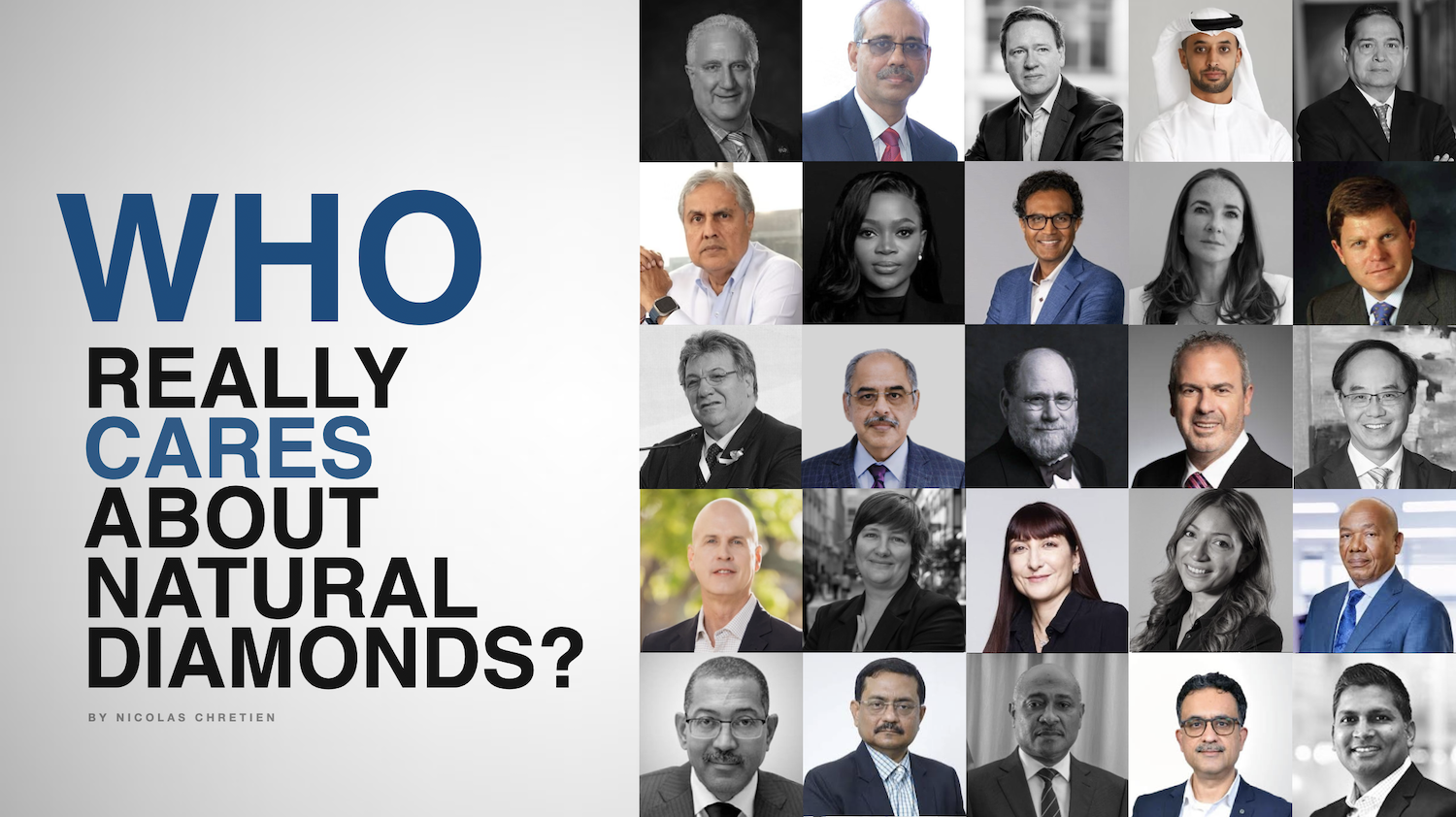
Who really cares about natural diamonds?

Not who cares about selling them, defending market share or protecting their organisation’s interests.
But beyond all that, who really cares about natural diamonds themselves—about their meaning, their cultural relevance, their heritage, their desirability, and what they will represent to generations that have not yet been born?

That is a very different question.
Singapore Was a Moment of Clarity
Before the 41st World Diamond Congress in Singapore, I published a post entitled If There Is One Thing the 41st World Diamond Congress Should Achieve…
I argued that after more than a century of building sophisticated infrastructure around mining, grading, manufacturing, trading and marketing, our industry had still failed to build something equally fundamental:
An infrastructure for its own heritage.
Not another marketing campaign. Not another industry organisation. Not a dusty archive. A living, innovative structure whose responsibility is to preserve, organise and bring the cultural meaning of natural diamonds to life—and turn that heritage into relevance and desire for future generations.
And I ended with a simple hope: “Let Singapore be where that commitment begins. Together.”
Singapore came and went, after a very well-organised Congress. But Singapore also gave me clarity.
Conversations, tributes and applause are not commitment.
At some point, commitment has to follow. That point is now.
We Have Built Almost Everything
The natural diamond industry has built remarkable infrastructure.
We know how to find diamonds beneath the earth. We know how to recover, sort, grade, cut, polish, certify, finance, transport, trace and trade them across continents. We have built an extraordinary industry around the diamond.
Perhaps therein lies part of the problem: much of our industry was built to trade diamonds as a commodity, while consumers ultimately experience them as a luxury product.
But have we built enough around its meaning?
That means bringing together expertise, archives, research, exhibitions, educational initiatives and innovation—not as isolated projects, but as part of a permanent institutional commitment to preserve, reinterpret and bring the cultural meaning of natural diamonds to life for new generations.
Three months ago, I asked another question: Where is the red box of the natural diamond industry?
The Cartier red box has almost no functional value. Yet everyone understands its value. Because it carries more than jewellery. It carries more than a century of mythology, history, craftsmanship, personalities, archives, exhibitions and deliberate cultural investment.
Cartier did not inherit that mythology by accident. It built it.
And then protected it, generation after generation.
For decades, Cartier has invested heavily in acquiring, preserving, researching, exhibiting and promoting its heritage, making it a defining part of the Maison’s identity. Cartier understood something our industry still struggles to understand:
Heritage is an economic asset.
It creates meaning.
Meaning creates differentiation.
Differentiation creates desire.
And desire creates value.
Heritage alone will not create the future of natural diamonds. Innovation, branding and contemporary culture will matter just as much. But heritage is one of the foundations on which all of them can build.
As technology makes more of our world reproducible, artificial and infinitely scalable, what cannot be manufactured—time, authenticity, origin, memory and human connection—will become increasingly valuable. Natural diamonds possess all of these. But possessing them is not enough. Their meaning has to be cultivated and transmitted.
Consumers may never ask for this infrastructure by name. But they experience what it produces: meaning, authenticity, differentiation and desire.
Who Is Responsible for Their Meaning?
The industry spends enormous amounts of time asking how to compete with lab-grown diamonds, rethink terminology, restore value, reach younger generations and rebuild desire for natural diamonds. All legitimate questions.
But perhaps another question needs to come first: Who feels responsible for natural diamonds themselves?
I don’t mean responsibility for the interests of a mining company, a bourse, an association or a marketing organisation. I mean responsibility for natural diamonds as a whole. I mean responsibility for ensuring that one of humanity’s most extraordinary natural treasures remains culturally meaningful fifty or one hundred years from now.
The industry has no shortage of organisations designed to represent interests at both global and local levels, regulate trade, defend standards and try to communicate with consumers. But representation is not stewardship. What remains missing is responsibility for the meaning itself.
Luxury houses have people whose responsibility is precisely this. They are custodians of the House.
Stewardship cannot simply be added to the already full agendas of people whose expertise and responsibilities lie elsewhere. It requires dedicated expertise, resources and, perhaps most importantly, time.
Who are the custodians of the House of Natural Diamond?
Passion Is No Longer Enough
I have met many people in this industry who genuinely love diamonds. Industry leaders. Historians. Gemologists. Cutters and designers. Retailers who believe in the magic of placing a natural diamond in someone’s hands. There is passion in this industry.
That is not what I question.
What I question is whether that passion has been translated into collective stewardship. Stewardship means understanding that something valuable has been entrusted to us temporarily—and that we have a responsibility to pass it on stronger than we received it.
We did not create them. We inherited them—from the Earth, and from the generations that gave them meaning before us. Sometimes that means investing in something that does not immediately benefit our own company or local market.
Supporting something our organisation does not control. Building something whose return cannot be measured next quarter. Thinking beyond our own mandate, presidency, balance sheet or generation.
That is harder.
But that is what great institutions and visionaries do.
The question is whether the industry is prepared to give this responsibility a permanent home, resources and governance.
Meanwhile, Dubai Is Building
Ahmed Bin Sulayem, Executive Chairman and CEO of DMCC, recently published an important article about DMCC’s decision to establish a dedicated lab-grown diamond vertical. It reflects something every industry needs: vision translated into action.
What interests me most is not the argument itself. It is what Dubai is doing about it.
It is building.
A dedicated vertical. A portal. Sector reports. A symposium. Connections with technology companies, producers, manufacturers, traders, investors and industrial users.
I do not see this as something the natural diamond industry should fear. I see it as something it should learn from. Because markets do not build their futures through declarations and panels.
They build institutions, determined not merely to adapt to the future, but to shape it.
The challenge is whether the natural diamond industry is prepared to bring that same commitment to building the infrastructure for its own meaning and heritage.
Which leaves me with another question:
Do We Have to Move to Dubai for Things to Happen?
Perhaps I Failed
I also have to ask the question of myself. Perhaps I failed to convince the industry. Perhaps I believed that demonstrating what could be achieved would naturally lead to institutional commitment. Perhaps I underestimated how difficult it is for an industry fragmented across organisations, commercial interests and centres of power to take collective responsibility for something that belongs to everyone.
For eighteen months, we built anyway. The beginnings of the World Diamond Heritage Board. Initiatives such as World Diamond Day and the World Diamond Heritage List.
All built around one central conviction: Natural diamonds are not merely a product category. They are part of humanity’s cultural heritage.
Perhaps the industry simply does not believe that building this kind of cultural and heritage infrastructure is necessary. Perhaps it believes that the organisations and initiatives already in place are sufficient. Or perhaps what I was trying to build was perceived by some as competition rather than contribution.
Those are legitimate possibilities.
But storytelling and stewardship are not the same thing.
The great luxury houses understood this long ago. Cartier has world-class marketing and communications, but it also has a dedicated heritage function. Different missions. Different expertise. Different responsibilities. Different people. One does not make the other unnecessary.
Whatever the answer, one thing has become clear to me: the responsibility itself does not disappear simply because we have not decided where it belongs.
At some point, the industry itself has to decide. And time is running short.
The Red Box Is Still Missing
Three months ago, I ended Where Is the Red Box of the Natural Diamond Industry? with three words: “In front of you.”
The opportunity is still there. But it will not be there forever. An extraordinary past does not guarantee relevance tomorrow. Ultimately, preserving heritage is not about looking backwards. It is about giving future generations a reason to desire what we inherited.
Cultural relevance has to be built.
Meaning has to be transmitted.
Desire has to be renewed.
And institutions have to take responsibility for doing it.
Laboratory-grown diamonds are organising their future.
Dubai is building.
Technology is moving.
Consumers are changing.
The extraordinary past of natural diamonds is already written. Their future is not.
So, I am left with one question: Who Really Cares About Natural Diamonds? And perhaps an even more important one:
Who Cares Enough to Act?
About the World Diamond Heritage Board (WDHB)
The World Diamond Heritage Board is an independent initiative dedicated to preserving, promoting, and transmitting the cultural, emotional, and historical value of natural diamonds across generations. World Diamond Day® is a registered trademark of WDHB.
About the author:

Nicolas Chrétien is a brand builder and strategist, creative leader, and founding member of the World Diamond Heritage Board (WDHB). With more than 35 years of experience in strategy, branding, and innovation, he has worked across luxury, consumer goods, and consulting, with a particular focus on natural diamonds, fine jewellery, and heritage-driven projects. Widely recognised for his creative, out-of-the-box thinking, he is known for developing unconventional frameworks that bridge strategy, marketing, creativity, and long-term value. Based in Singapore, he is actively involved in shaping future-facing frameworks for the diamond industry through WDHB initiatives.
Social media detail: https://www.linkedin.com/in/n-chretien/
Articles about World Diamond Heritage Board (WDHB) and Nicolas Chrétien:
https://gem-spectrum.com/tag/world-diamond-heritage-board