
(Anton Watzl Minerals coll.)
Heliodor is the varietal name for the yellow beryl, a mineral mostly known for its green and blue varieties (emerald and aquamarine, respectively) being a typical Greek-origin name meaning gift from the Sun, from helios, “Sun” and doron, “gift”.
Although it is a well-known gemstone among gemmologists, but not that well-known in jewellery worldwide, it is among mineral collectors that it is probably more highly appreciated. Well-developed hexagonal prism crystals are very popular, especially those from Khoroshiv Raion (former Volodarsk-Volynskii until 2016), Zhytomyr Raion in Zhytomyr Oblast, Ukraine.

The old name Volodarsk-Volynski, was known among mineralogists due to its pegmatitic fields (known as Volyn pegmatites) where very large crystals, sometimes larger than 20 kg, are known to occur. Heliodor is also found in notably in Brazil, Namibia and USA.
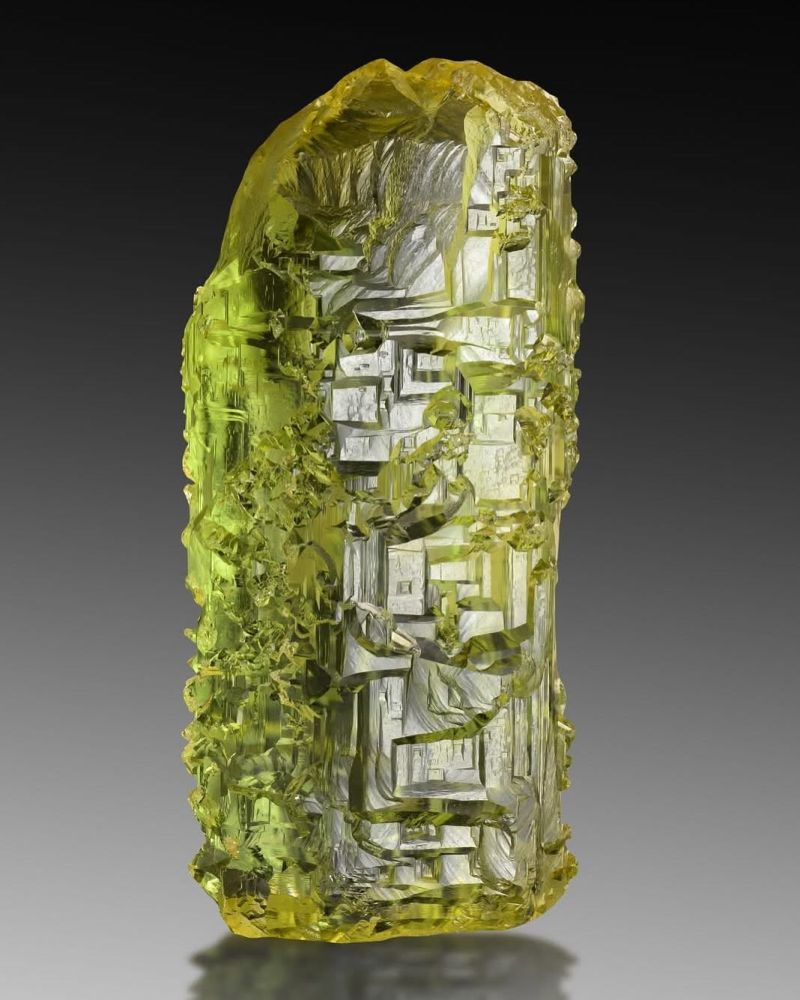
In the photo, a remarkable doubly-terminated 6.5 x 3.0 x 2.5 cm crystal (Anton Watzl Minerals coll.) is a typical example of fine Ukrainian material, where the prism crystal faces show etch marks (also named etch pits or figures) that are alterations of the surface that result from dissolution (etching) during growth caused by chemical disequilibrium or high temperature.
The shape of these figures is controlled by the crystal structure, being educational examples to address symmetry in crystallography as well as crystal growth thermodynamics in mineralogy.

This is when the science behind this mineral beauty totally justifies the wide appreciation for this natural crystalline form instead of having a master cutter fashioning it into a faceted or carved masterpiece.
What would you do here?

Guest articles by Rui Galopim de Carvalho:
https://gem-spectrum.com/category/rui-galopim-de-carvalho

About the author:
Rui Galopim de Carvalho is a renowned independent Gem Education Consultant, author, luxury industry training expert and popular international lecturer on gemmology and on the history of gem materials. During his 30 year experience as a gemmologist, Rui has studied important collections in both public and private museums, notably the Portuguese Crown Jewels.
Founder of the popular Home Gemmology webinar series launched during the COVID-19 lockdown, Rui has a long history as a gemmology communicator, notably on social media where he is a popular figure.
Rui Galopim de Carvalho can be reached through his website: