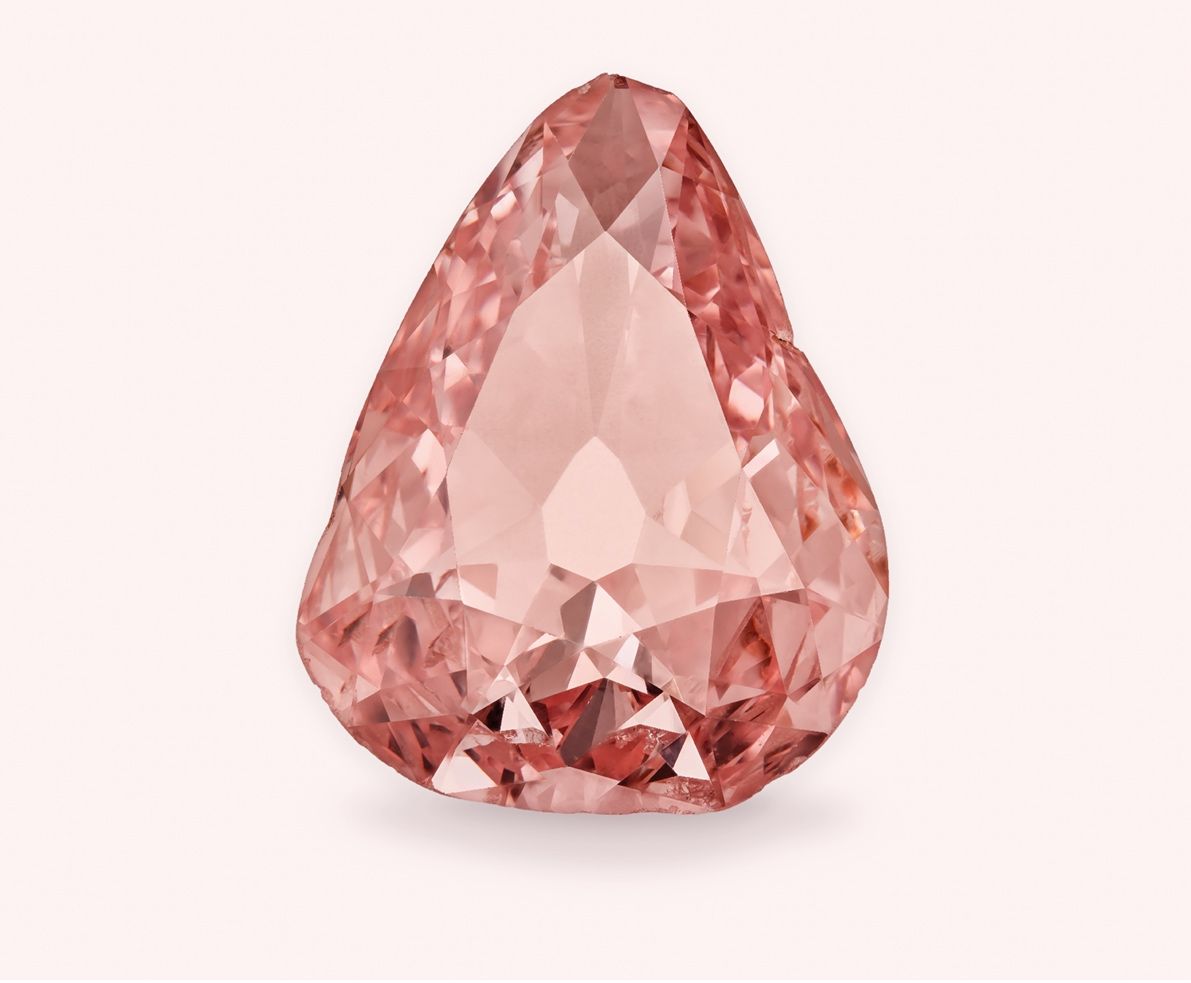

In anticipation of the forthcoming exhibition at the Château de Chantilly (officiel) in partnership with L’ÉCOLE, School of Jewelry Arts, let’s unveil a few details about the Grand Condé Diamond, an irregular pear shaped antique brilliant cut (with fascinating a stellar facet arrangement around the culet) that was first documented in 1740 as part of the collection of Louis Henri de Borbon, Prince of Condé, at the Château de Chantilly.
It eventually became property of queen Marie-Amélie of Bourbon-Sicily (here on a c. 1835 portrait by Louis Hersent © RMN-Grand Palais, Gérard Blot) who gave it for her grandson Louis of Orléans, eldest son of the Duke of Aumale.


Later in 1886, the Duke d’Aumale bequeathed it to the Institut de France, having been stolen in 1926 and recovered soon after, being currently at the Musée de Condé in Chateau de Chantilly that, before the above-mentioned bequest, belonged to the Condé family.
The rarity of this diamond is not only a matter of being a pink diamond with a documented 18th century existence, with a very interesting irregular modified pear-shape brilliant cut, but also its cause of colour, related to plastic deformation in a type IIa diamond (no detectable nitrogen in infrared spectroscopy).
Sometimes the trade calls these Golconda diamonds. Given the documented age of the diamond, the origin may be both India and Brazil, possibly even Borneo, but maybe the exhibition to-be-published research, with Laboratoire Français de Gemmologie, may shed light on this.

This exhibition, curated by Marie-Laure Cassius-Duranton and Mathieu Deldicque, is (another) great and fancy reason to visit France this autumn.

Photos © L’École, School of Jewelry Arts, Benjamin Chelly

Guest articles by Rui Galopim de Carvalho:
https://gem-spectrum.com/category/rui-galopim-de-carvalho

About the author:
Rui Galopim de Carvalho is a renowned independent Gem Education Consultant, author, luxury industry training expert and popular international lecturer on gemmology and on the history of gem materials. During his 30 year experience as a gemmologist, Rui has studied important collections in both public and private museums, notably the Portuguese Crown Jewels.
Founder of the popular Home Gemmology webinar series launched during the COVID-19 lockdown, Rui has a long history as a gemmology communicator, notably on social media where he is a popular figure.
Rui Galopim de Carvalho can be reached through his website: