
It is said that moonstone is one of the birthstones of June, and although I am not personally a big fan of the concept of birthstones, I do find it, however, useful as an excuse to talk about less usual gemstones, like this one.
Moonstone is the collective trade name for the iridescent varieties of a selected group of feldspars, namely adularia (orthoclase) and iridescent peristerite (albite-oligoclase) and, also, anorthoclase and antiperthite that may also show similar optical effects and may also be classified as moonstone in the trade.
The term has also been used to describe colourless iridescent (labradorescent) andesine-labradorite feldspar known in the trade as “rainbow moonstone”.

The most common variety as a gemstone is adularia moonstone, typically colourless to white coloured, sometimes yellow or grey, that is most prized when exhibiting adularescence, the so-called schiller effect.

This optical phenomenon is caused by a combination of light scattering from very tiny particles (the so-called Tyndall effect) and iridescence caused by thin film interference in crystallographically-related twinning planes.
Historically known in Austria, moonstone occurs in Sri Lanka, Myanmar, Tanzania, India, Madagascar and USA (New Mexico).


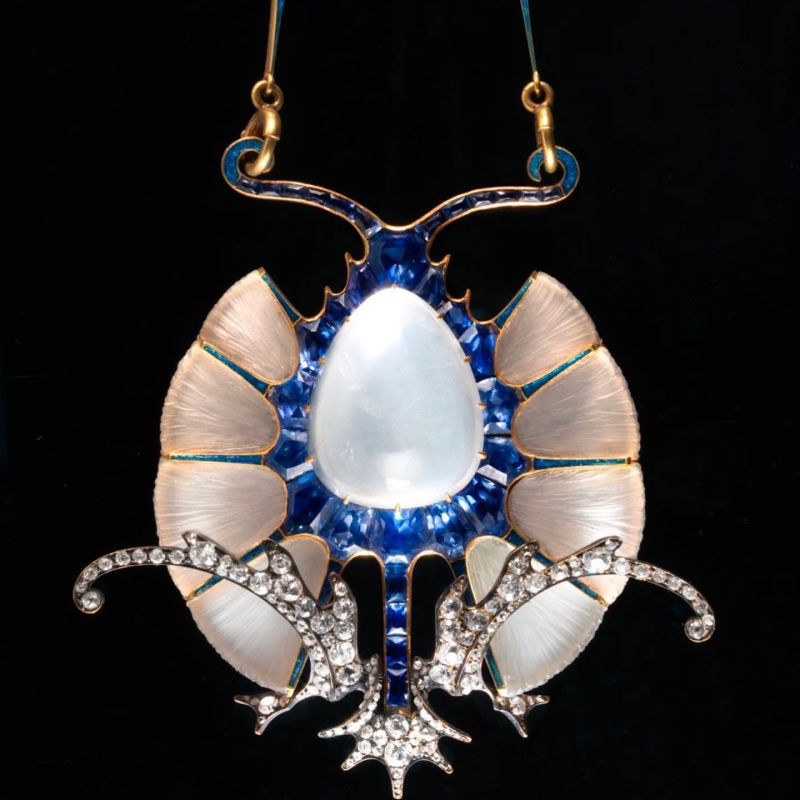
In the photo, the ‘Thistle’ pendant by René Lalique, ca. 1898-1900 © Calouste Gulbenkian Foundation; a pair of earclips by JAR, set with diamonds, sapphires and fine-quality moonstone © FD Gallery; a 5.7 ct faceted labradorite, var. rainbow moonstone from Malawi © Smithsonian National Museum of Natural History
Guest articles by Rui Galopim de Carvalho:

https://gem-spectrum.com/category/rui-galopim-de-carvalho

About the author:
Rui Galopim de Carvalho is a renowned independent Gem Education Consultant, author, luxury industry training expert and popular international lecturer on gemmology and on the history of gem materials. During his 30 year experience as a gemmologist, Rui has studied important collections in both public and private museums, notably the Portuguese Crown Jewels.
Founder of the popular Home Gemmology webinar series launched during the COVID-19 lockdown, Rui has a long history as a gemmology communicator, notably on social media where he is a popular figure.
Rui Galopim de Carvalho can be reached through his website: