
Terminology for gem corundum coloured by chromium has always puzzled me for historical, technical and practical reasons.
Up until the 20th century, pink to red corundum was classified as ruby, or oriental ruby, sometimes romantically referred to as female ruby (pink) and male ruby (red).
Today, the term “pink sapphire” is well established in modern gemstone terminology and the stakeholders of the trade use it with its meaning as established by current trade standards: pink gem variety of corundum.
Curiously, though, technically, pink can be understood as the same hue, red, but with a different tone (value) and saturation (chroma), meaning, in simpler words, that pink and red are basically the same colour (like blue and light blue: both blue). This means that the historical understanding of the term was not incorrect at all.

To complicate things a bit, perception of colour within pink to red corundum is dependent upon many factors: the type of illuminant and light environment used for the observation; the cutting style and proportions; the orientation of the optic axis with the table facet and the angle of observation; and with orientation/position of the stone; and the viewer’s visual acumen.
To add complexity, to clearly separate between pink sapphire and ruby in a laboratory there are a combination of factors involved with established controlled observation conditions and a comparison test with a master set following certain protocols.
The interesting fact is that there is no international standard for this separation, but historically there never was one anyway because these gem corundums were just called “rubies”.
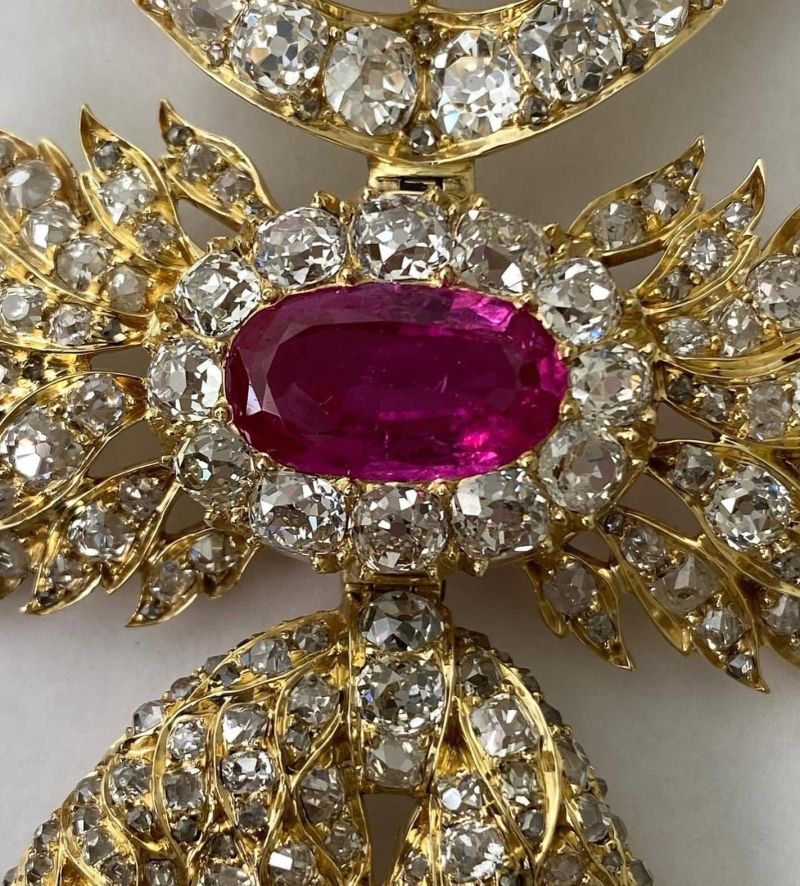
In the photo, a c. 4.4 ct pink sapphire from Sri Lanka (?) set on a 19th century gold and diamond insignia of the Order of the Golden Fleece at the Museu do Tesouro Real – Palácio Nacional da Ajuda, in Lisboa, Portugal © Rui Galopim de Carvalho.
Guest articles by Rui Galopim de Carvalho:
https://gem-spectrum.com/category/rui-galopim-de-carvalho

About the author:
Rui Galopim de Carvalho is a renowned independent Gem Education Consultant, author, luxury industry training expert and popular international lecturer on gemmology and on the history of gem materials. During his 30 year experience as a gemmologist, Rui has studied important collections in both public and private museums, notably the Portuguese Crown Jewels.
Founder of the popular Home Gemmology webinar series launched during the COVID-19 lockdown, Rui has a long history as a gemmology communicator, notably on social media where he is a popular figure.
Rui Galopim de Carvalho can be reached through his website: