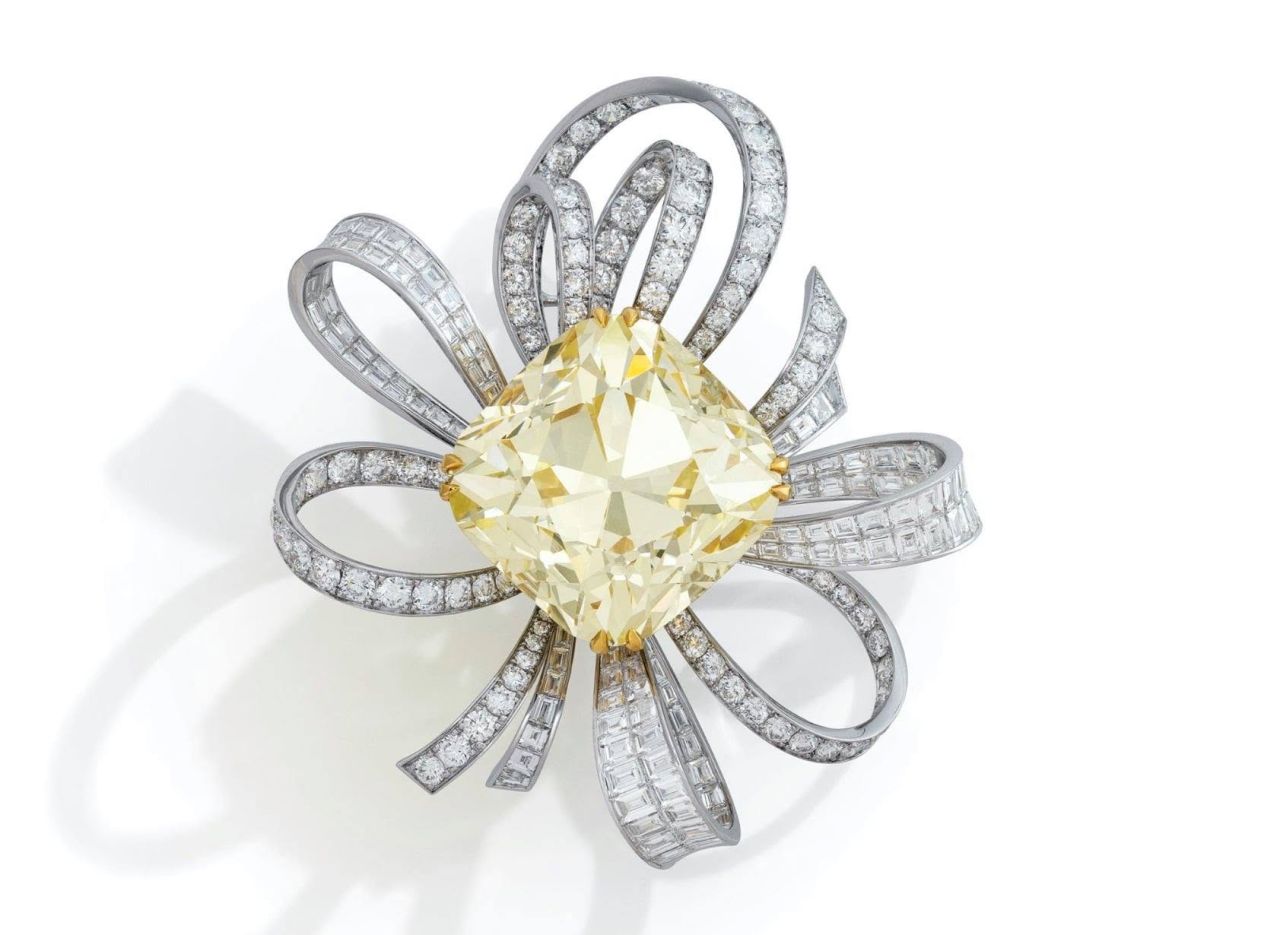
Being a Portuguese national, I have always been intrigued by the “Portuguese Diamond”, that is among the largest cut diamonds on public display. This type Ia 127.01 ct diamond, measuring 32.75 x 29.65 x 16.01 mm with a faint brownish-yellow colour (graded M colour) and VS1 clarity has a noticeable cloudy appearance due to a very strong bluish fluorescence (as depicted bellow) caused by crystal defects (nitrogen impurities and vacancies that are arranged in a certain way along the crystal lattice of the mineral).

It was fashioned into an Asscher cut from a 150 ct cushion shaped stone that belonged to American Broadway actress, model and dancer Peggy Hopkins Joyce. It was previously cut from a rough stone reportedly from the Premier mine (now Cullinan mine) in South African, found in 1910.

Harry Winston bought the stone in 1951 and then traded it for 3,800 carats of small diamonds with the Smithsonian National Museum of Natural History in 1963, where it still resides as the largest cut diamond of the collection.

Its name remains a mystery as it has no documented relationship with Portugal, any former Portuguese diamond producing colony (e.g. Brazil, Angola) nor known previous Portuguese ownership. If you got this far in the post you’ve realized that there is no connection with Portugal whatsoever…
Guest articles by Rui Galopim de Carvalho:

https://gem-spectrum.com/category/rui-galopim-de-carvalho

About the author:

Rui Galopim de Carvalho is a renowned independent Gem Education Consultant, author, luxury industry training expert and popular international lecturer on gemmology and on the history of gem materials. During his 30 year experience as a gemmologist, Rui has studied important collections in both public and private museums, notably the Portuguese Crown Jewels.
Founder of the popular Home Gemmology webinar series launched during the COVID-19 lockdown, Rui has a long history as a gemmology communicator, notably on social media where he is a popular figure.
He is associate editor of Gem-A’s Journal of Gemmology, Vice-President of the Coral Commission of The World Jewellery Confederation – CIBJO, member of the Communications Committee of ICA (International Colored Gemstone Association), ambassador for LAUREL -Portuguese Association of Excellence Brands (ECCIA member) and consultant for several private collections and trade organizations.
Rui Galopim de Carvalho can be reached through his website: