by Javier Garcia-Toloza, CEO Technological Development Center for the Colombian Emerald CDTEC
& Guillermo Galvis, President of Colombian Emerald Exporters Association

For two decades, CDTECGemlab has been at the forefront of research and certification of the Colombian emerald, safeguarding its prestige in the global market. The laboratory is part of the Colombian Emerald Technological Development Center Corporation (CDTEC), a non-profit organization established in 2004 by government agencies and leading associations representing the national emerald sector.
The origins of CDTECGemlab trace back to the early 1990s, when industry leaders identified the need for a specialized center to provide technical and scientific support to the emerald trade. This vision gained momentum during the first World Emerald Congress in 1998, where the concept of creating a dedicated emerald research facility was formally proposed.

Funded by the National Emerald Fund (FNE) and backed by its governing committee—along with the Ministry of Mines and Energy, the National Emerald Federation of Colombia (FEDESMERALDAS), and the main associations of the supply chain: producers (APRECOL), traders (ASOCOESMERAL), and exporters (ACODES)—CDTECGemlab was created to meet the sector’s growing demands for quality assurance and technological advancement.
Strategically located in Bogotá’s main emerald trading district, the lab operates from its central headquarters while also offering mobile services across Colombia. Over the years, CDTECGemlab has extended its expertise to both national and international stages, providing gemological services at prestigious events such as the Jewelry and gemstones Hong Kong Show.


CDTEC’s mission encompasses research, education, technological innovation, and the provision of specialized gemological services. Its research portfolio spans topics such as substances, cleaning processes, origin determination through advanced analytical techniques, the geochemical fingerprint of the Colombian emerald, environmental assessments in emerald mining regions, and studies on the genesis of Colombian emeralds. Many of these investigations have been conducted in partnership with leading national and international universities and research institutions.
From the outset, CDTEC has placed a strong emphasis on quality assurance, ensuring that its services and products meet the highest global standards. This dedication includes the ongoing pursuit of accreditation under ISO/IEC 17025 an international standard for the technical competence of testing and calibration laboratories—alongside strict adherence to recognized industry references such as the CIBJO Blue Books and the Laboratory Manual Harmonization Committee’s sheet-work.
By combining state-of-the-art technology with a highly skilled team, CDTEC has developed procedures and methodologies grounded in ethics, transparency, and reliability. Among its most respected outputs is the gemological report, prepared in full compliance with international standards. These reports are trusted by professionals and institutions worldwide, reinforcing Colombia’s position as a leader in the global emerald industry.

CDTECGemlab’s facilities are equipped with both standard gemological instruments, traditional gemological tools—such as refractometers, dichroscopes, and microscopes—and cutting-edge systems for molecular spectroscopy and atomic analysis. Among its most valuable tools is the Fourier Transform Infrared Spectrophotometer (micro-FTIR). Beyond identifying materials and detecting enhancement substances in emeralds, this technology supports the development of advanced analytical methods—ranging from determining geographic origin (González-Ruiz et al., 2022) to pinpointing the presence of substances in specific areas of a gemstone, such as along individual fissures. Its versatility even extends to analyzing stones setting in finished jewelry pieces.
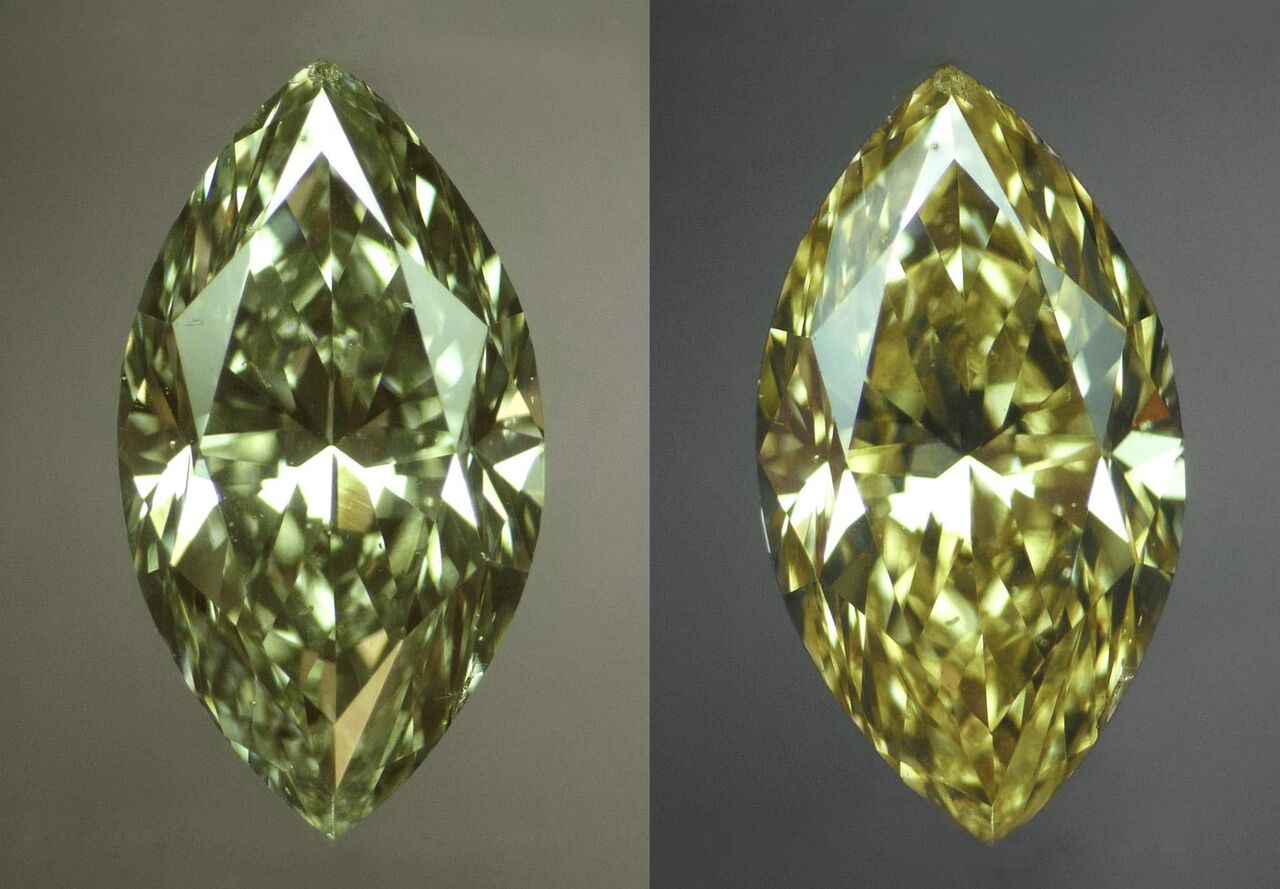
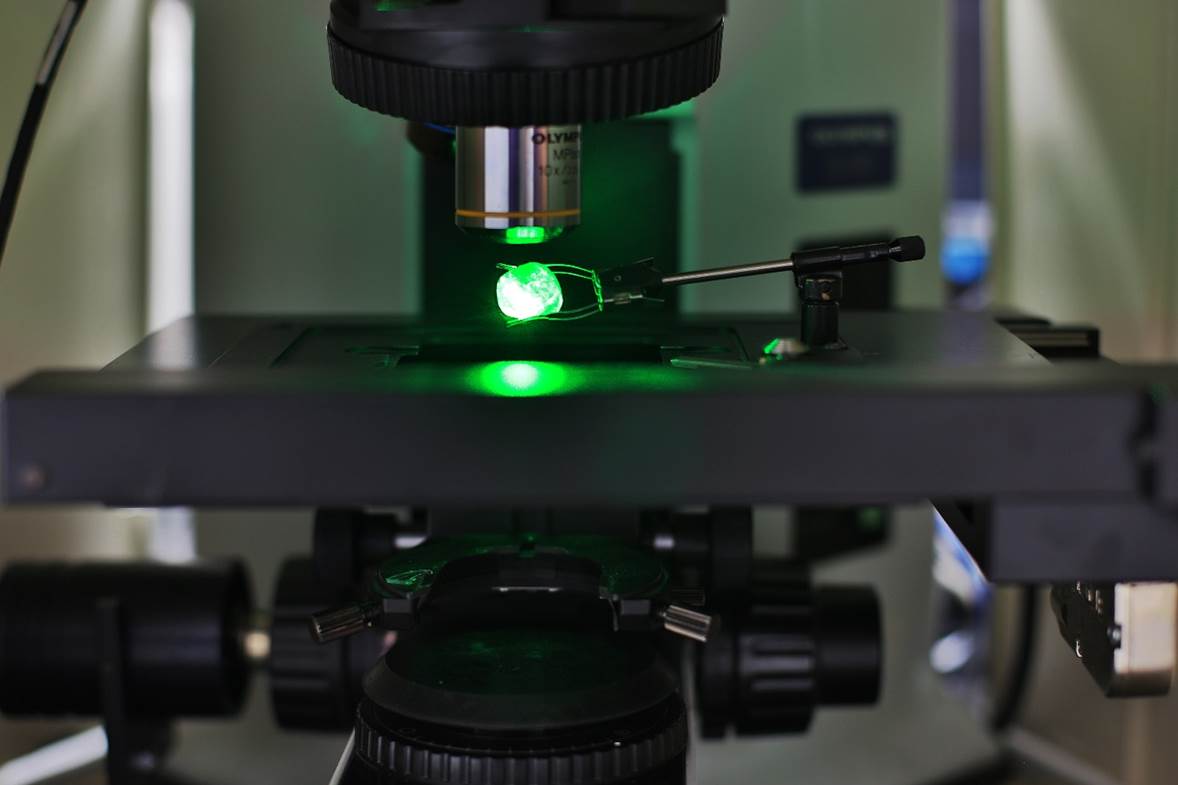
Complementing this is the micro-Raman spectrophotometer, a versatile tool for identifying a wide variety of materials and, for emeralds, detecting treatments and enhancements. In the analysis of different stones, such as diamonds, it can reveal whether a stone has undergone treatment, determine its natural or synthetic origin, and more. This instrument plays a key role in research into the genesis of emeralds, particularly through the study of fluid inclusions (Romero Ordoñez et al., 2021). Furthermore, photoluminescence studies conducted with the micro-Raman have enabled researchers to correlate Colombian emeralds with their principal geological host formations—the Muzo and Chivor Formations (García-Toloza et al., 2024)—insights that are now integrated into internationally recognized gemological reports.
The X-ray fluorescence (XRF) system enables CDTECGemlab to precisely determine the concentrations of chemical elements within analyzed materials. Beyond its routine applications, it plays a key role in research aimed at understanding the elemental composition of rocks and other minerals linked to the geological formation of Colombian emeralds (González-Durán et al., 2021). Additional spectral information is obtained with the visible–ultraviolet spectrophotometer with near-infrared capability, which can identify transition elements embedded within a material’s structure. The arrangement of these elements governs how they interact with light—producing distinctive absorption patterns that are critical for material characterization (Cedeño-Ochoa et al., 2015).


Together, these instruments generate a comprehensive and complementary dataset: molecular and structural analyses reveal treatments and origins, elemental characterization uncovers the chemical signature of both gems and host rocks, and optical spectroscopy defines each material’s unique interaction with light. This integrated approach ensures a more accurate, reliable, and scientifically robust understanding of Colombian emeralds—knowledge that strengthens their traceability, authenticity, and global reputation.
At the heart of CDTEC’s work is its multidisciplinary team of professionals, including gemologists, geologists, physicists, and chemists. Their combined expertise fuels both pioneering research and the delivery of world-class gemological services, reinforcing Colombia’s position as a global leader in emerald science and certification.
Education has become one of the institution’s defining pillars, carrying knowledge of gemology, emeralds, and their quality factors to audiences across the globe. In Colombia, CDTEC has developed programs in partnership with the Ministry of Mines and Energy, SENA, and FEDESMERALDAS, reaching not only professionals within the emerald supply chain but also residents of mining regions, equipping them with tools and training to improve their livelihoods.

Over the past two decades, collaboration between the public and private sectors has shaped CDTEC far more than a provider of gemological services. Through research, technological innovation, and industry support, it has become an essential ally to all stakeholders in Colombia’s emerald industry. This role has been formally recognized by government authorities—most notably when the city of Bogotá honored CDTEC with a special distinction on its 20th anniversary, celebrating its contributions to both the city and one of Colombia’s most iconic production sectors.
This article was published and printed on Gem Spectrum print magazine Issue #4 Summer 2025, page 30. Please browse the Flipbook below (full screen viewing possible).