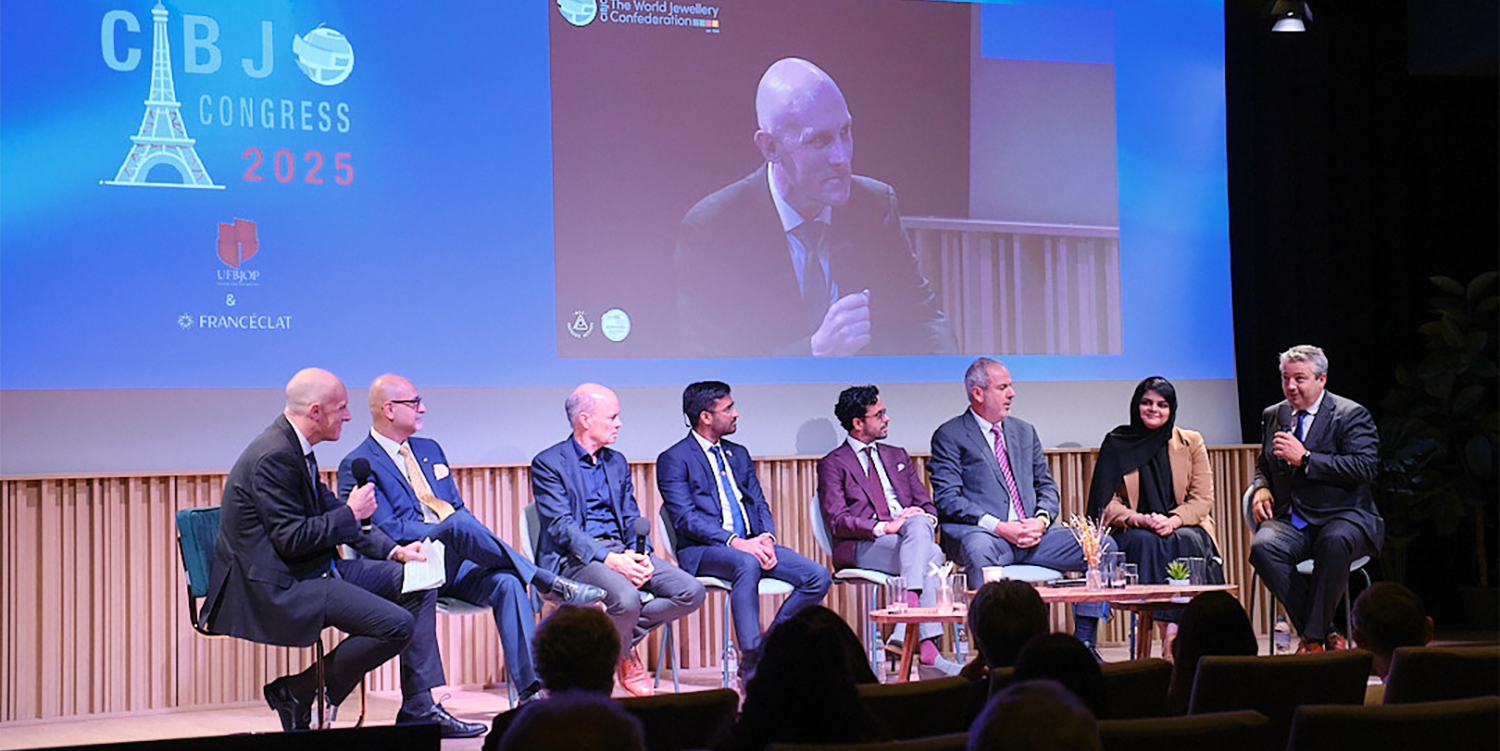


Confusion among diamond jewellery customers and how to boost demand, notably in China, are among the biggest challenges facing the industry presently, the CIBJO Congress has heard.
A panel discussion, moderated by diamond analyst Avi Krawitz, heard concerns over the diamond industry at a crossroads, with much focus centred on confusion among consumers over whether to buy natural or synthetic diamond jewellery.
Mahiar Borhanjoo of De Beers Group said consumers were often misled in retail stores over the intrinsic qualities of natural or synthetic diamond jewellery.
He said the key to explaining natural polished diamonds to consumers in retail stores, lay in telling the story of the journey of the diamond from the earth’s crust to the store.

Part of that story lay in talking about health, infrastructure and and educational assistance provided to the diamond mining countries and communities by diamond producers, particularly in developing countries, Mr Borhanjoo added.
David Kellie, CEO of the Natural Diamond Council (NDC), referred to worries over the softness of demand for natural diamond jewellery in China, whose economy has struggled since the pandemic lockdowns.


Ravi Bhansali, Vice President of the AWDC and CEO of diamonds supplier Rosy Blue, said Chinese consumers were cautious to spend their disposable income on diamond jewellery.
Mr Kellie said that many consumers now wanted to spend more on experiences than physical luxury goods, representing a further challenge to the diamond jewellery industry.
He also referred to ongoing big retail margins for synthetic diamond jewellery, which had contributed to erode the market share of natural diamond jewellery.
Brijesh Dholakia, CEO of Hari Krishna Exports, a diamonds supplier, said he was concerned over the outlook for key markets for diamond jewellery.
He added that he saw more market opportunities for diamond jewellery sales in India, where the economy is still growing briskly, than China presently.
Yoram Dvash, President, World Federation of Diamond Bourses, said he was concerned over the impact of tariffs on the diamonds trade, making diamond exports from producing countries very challenging.
He added that the sharp increase in turnover of synthetic diamond jewellery had surprised many in the industry despite a decrease in prices of synthetic diamonds.
Retailers were still making strong margins on sales of synthetic diamond jewellery, as they had benefited from the fall in price of synthetics, Mr Borhanjoo said.
Didier Backaert of Bonas Group referred to differing levels of competition between synthetic and natural diamonds depending on the market segment.
Wafa Jaffery, senior executive, precious stones at Dubai’s DMCC (Dubai Multi Commodities Centre), noted that technological advances in the offer of synthetic diamonds had contributed to the increased market share for synthetic versus natural stones.
The Digital Binder of the 2025 CIBJO Congress is also now online.

It contains documents that will be referred to during the various sessions, as well as the other relevant materials. The Digital Binder can be accessed at:
https://cibjo.org/congress-2025/digital-binder-2025/
Articles about CIBJO:
https://gem-spectrum.com/tag/cibjo