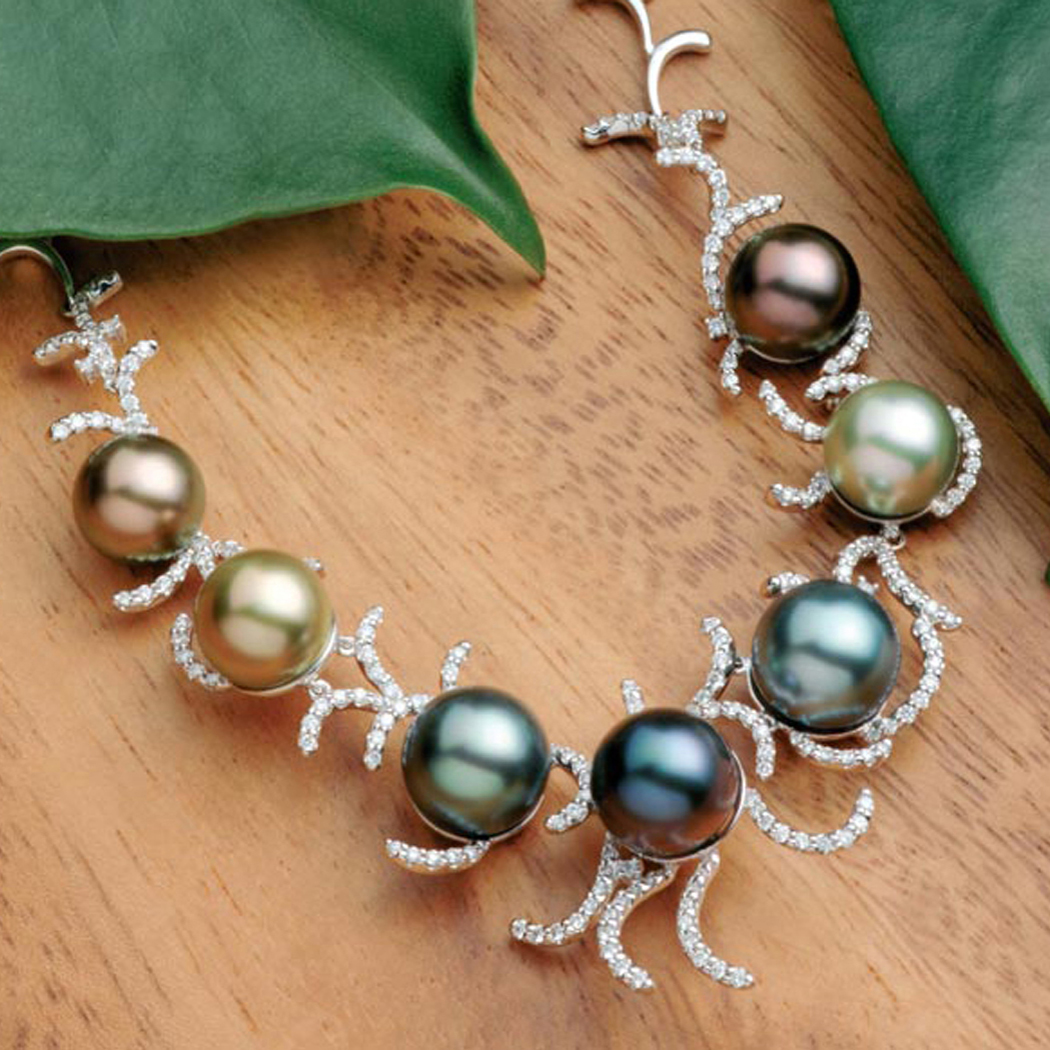

When Tahitian cultured pearls were introduced to the market in the 1970s, most had a gray to black body color because they are from the black-lipped oyster, which can produce darker pearls than silver-lipped South Sea pearl oysters.
Since the pearls were a different color than other pearls on the market in the 1970s, jewelers wondered if the Tahitian pearls had been dyed, but GIA lab reports identified them as natural-color cultured pearls and alleviated their concerns.
In the 1990s, Tahitian cultured pearls gradually became more colorful as techniques were developed to cultivate pearls in black-lipped oysters with a variety of natural body colors. In addition to black and gray, Tahitian cultured pearl body colors can be brown, green, blue, pink, purple, yellow or in rare cases white.
Overtones, when present tend to be green, pink, purple or blue. The choice of the mantle tissue graft plays an important role in determining pearl color. The environment in which oysters are grown and trace elements in the water can also affect the color of pearls.
All pearls sold in French Polynesia are of natural color, but after they are exported, they may be treated. Do not assume that all pearls identified as Tahitian pearls on the Internet are from the black-lipped saltwater oyster.
Many are low-grade cultured freshwater pearls that have been dyed and then sold on the Internet as Tahitian pearls often with imitation pearl prices. Only pearls of natural color with an adequate nacre thickness can display the lustrous overtone colors seen on true Tahitian cultured pearls.
The Spring 2016 issue of “Gems & Gemology” has an article on Tahitian “pistachio“ colored (greenish-yellow) pearls treated by Ballerina Pearl Co.
It states: “these pistachio colors are usually modified from natural gray to dark gray colors by a series of chemical and physical processes. No foreign coloring agent was detected in this study, and the treatment was generally stable.”
I used this photo in an article I wrote on Tahitian pearls in the current May issue of “Jewellery Business” magazine.
About the author:
Renée Newman is a gemologist (GG, GIA), lecturer, writer and author of 15 books on gems and jewelry. Her goal is to provide consumers and jewelry professionals with unbiased, affordable information on how to buy, evaluate and appreciate gems and jewelry. She can be reached through her website: