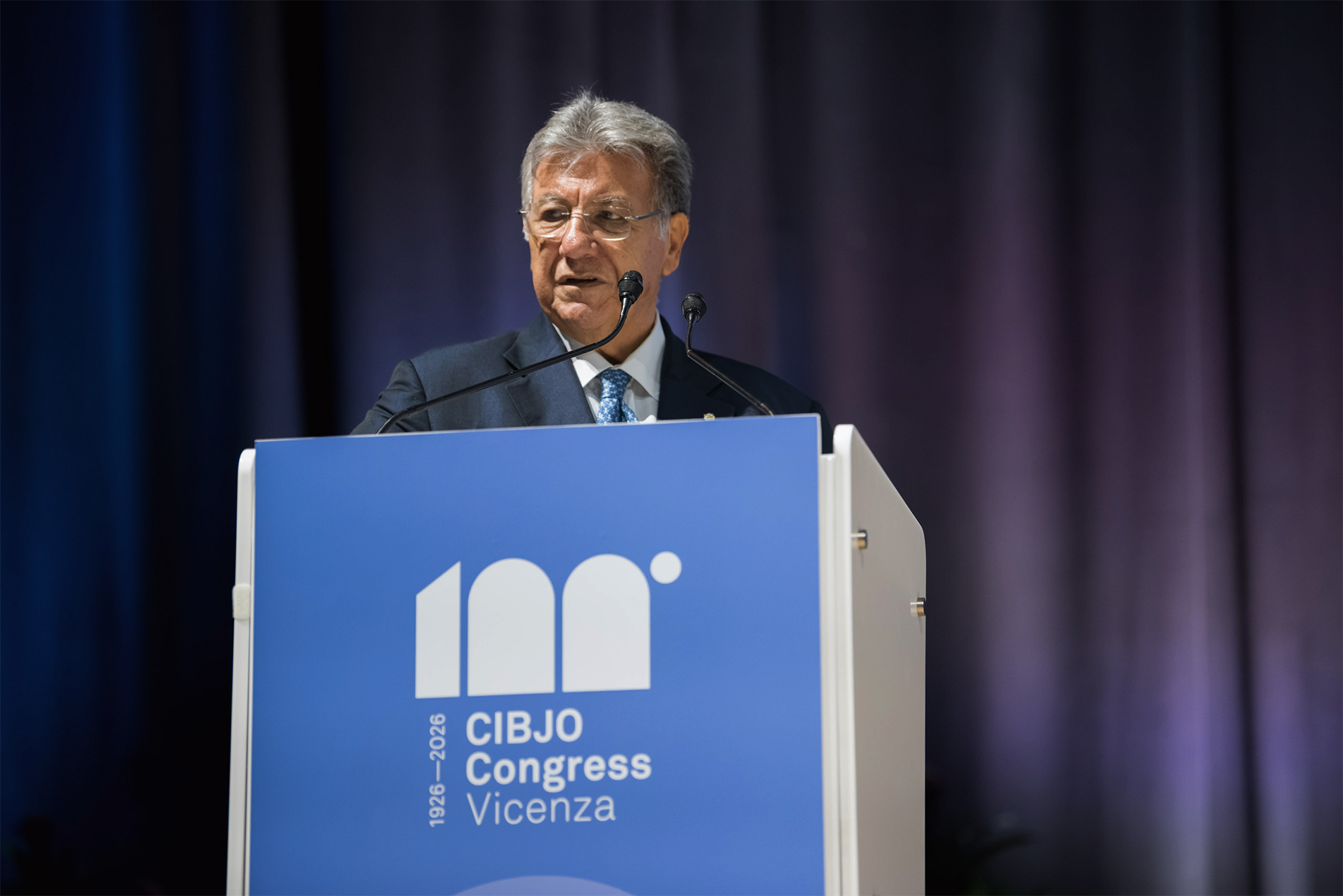


Ladies and gentlemen,
Benvenuti in Italia, nella splendida città di Vicenza e all’inizio del nostro secondo secolo!
Welcome to Italy, to the beautiful city of Vicenza, and to the beginning of CIBJO’s second century!
For the oldest international association in the world jewellery industry, there is arguably no more fitting a location to celebrate this momentous milestone. We are gathered today in a place where there is archaeological evidence that jewellery was being crafted as far back as the Eighth Century BC—meaning that the Veneto region has an unbroken connection with what we do stretching back at least 3,000 years!
Vicenza is also a place that has historically shared CIBJO’s sensibility. As you know, our World Jewellery Confederation is dedicated to formulating and promulgating the highest standards and business principles for our trade. In 1339—687 years ago—the City of Vicenza established a goldsmiths’ guild called the Fraglia degli Orafi, to set strict standards for purity and craftsmanship.
Our thanks go to President Maurizio Ermeti and to the hardworking, talented and generous team at the Italian Exhibition Group for welcoming us into their home. For our industry, this place is the modern embodiment of the ancient Roman Forum—the central meeting place where politicians, thinkers and businesspeople come together. It is a most fitting location for a CIBJO Congress.
CIBJO traces its origins to a meeting of jewellery-industry leaders held one century ago, in April 1926. There, they agreed to create a pan-European association called the Bureau International de la Bijouterie, Orfèvrerie, Argenterie—in English, the International Bureau of Jewellery, Goldsmithing and Silverware Trades. It became known as BIBOA.
BIBOA’s membership consisted of representatives of professional organisations from across the continent, chambers of commerce and other affiliated associations. It operated in a way not dissimilar to how CIBJO does today, establishing some of the world’s first unified trade rules for gemstone disclosure. It also established commissions dealing with precious metals, precious stones and pearls, and held congresses every two to three years.
The president of BIBOA from its establishment until his death in
1956 was Carel Joseph Anton Begeer, a legendary Dutch silversmith. Many credit him with helping the European jewellery industry to recover after the Second World War. His son, Sebastiaan, succeeded him briefly as president of BIBOA and later served as CIBJO president from 1963 to 1967.
CIBJO in its modern form was conceived at a congress in Paris in June 1960. There, it was agreed that BIBOA should be reconstituted as an association open to members from across the globe. By then, it had become increasingly obvious that the European framework was too narrow, particularly in view of the supplier–customer relationships developing between countries on di[erent continents.
At a congress in 1961, BIBOA was formally disbanded and restructured as CIBJO, the Confédération Internationale de la Bijouterie, Joaillerie, Orfèvrerie des Diamants, Perles et Pierres. Its first president was Jean Saglier. New by-laws were adopted that opened membership beyond Europe, allowing nations from the Americas, Asia, Africa and Oceania to join the assembly. The 1961 Congress also laid the foundations for CIBJO’s sectors, which divide administrative responsibilities between di[erent groups in order to balance the interests of miners, gemmological laboratories, manufacturers and retail distributors.
Over the ensuing decades, CIBJO developed its renowned system to advance the goal of universal standards and terminology in the jewellery industry.
The first three sets of standards were introduced in 1968: the gemstone book, with a blue cover; the diamond book, with a grey cover; and the pearl book, with a green cover. They soon came to be referred to collectively as the Blue Books.
In 2007, CIBJO launched the Precious Metals Blue Book, followed in
2010 by the CIBJO Gemmological Laboratory Book. The CIBJO Coral
Book was added in 2015, and in 2019 the Responsible Sourcing Blue Book was introduced, reflecting growing global concern about ethical supply chains. Collectively, they form the world’s most universally accepted set of jewellery-industry standards, and they served as the basis for three diamond standards created by ISO— the International Organisation for Standardisation—for each of which a CIBJO o[icer headed the technical committee that helped create it.
But CIBJO in 2026 is not just a standards-setting body, even though we take that role very seriously.
More significant, most probably, is our status as the single jewelleryindustry association encompassing the entire globe, as well as all the various supply chains—from mine to retail marketplace—in each of our industry’s component parts: coloured gemstones, diamonds, pearls, coral and other biogenic materials, and precious metals.
We cover, in their entirety, an international business community whose total turnover in 2026 has been conservatively estimated at $250 billion, with more generous estimates putting it as high as $409 billion.
There is no organisation other than CIBJO capable of bringing so large and representative a body of industry representatives into one room, as we have done today. Here in this theatre, you are joined by miners, both industrial and artisanal; pearl farmers; precious-coral harvesters; rough dealers; jewellery designers and manufacturers; wholesalers; independent retailers; world-renowned brands; and the full gamut of those who support them, including gemmological laboratories, technology companies, financiers and the media. You are all a snapshot of our great jewellery industry.
This sense of community and collective responsibility is, in many respects, the most notable feature of the 21st century, which began in the shadow of the conflict-minerals crises in Africa. That sombre time, however, sparked a realisation that our luxury industry had the potential to become a force for positive social and economic development.
In 2006, CIBJO became the first and only organisation in the diamond, gemstone and jewellery sectors to be granted o[icial consultative status with the UN Economic and Social Council. The following year, at our first Congress on the African continent, we issued the Cape Town Declaration, which committed our industry to supporting the UN development goals. We have never looked back.
Let us be clear: as a business community that, in the not-toodistant future, should be generating more than half a trillion US dollars in revenue annually, we have the ability to be a
transformative force for human development. We may deal in luxury, rather than essential products, but in many of the countries where we operate, we are nothing short of essential.
This is the continuing legacy of CIBJO and the greater jewellery industry as we begin our second century.
Over the coming four days, we will do what we have collectively done for more than 100 years: consider industry standards, operating principles and nomenclature. But we will also consider the disruptive times in which we live and the complicated geopolitical climate. And we will look ahead to our inevitably changing world, driven by new technologies such as AI.
To look forward, we are supported by the contributions of those who preceded us, like Carel and Sebastiaan Begeer, and Jean Saglier; the other presidents and o[ice-holders about whom we read; and those whom we knew well but who, sadly, are no longer with us—such as Jose Hess, my predecessor as CIBJO president, and our friends and close colleagues Roland Naftule and Harry Levy, among many others who also deserve special mention. This is a poignant moment, but also an exciting one. I wish us all a wonderful Centenary Congress.
CLICK TO DOWNLOAD TRANSCRIPT OF SPEECH
Articles about CIBJO:
https://gem-spectrum.com/tag/cibjo
Articles about VicenzaOro:
https://gem-spectrum.com/tag/vicenzaoro